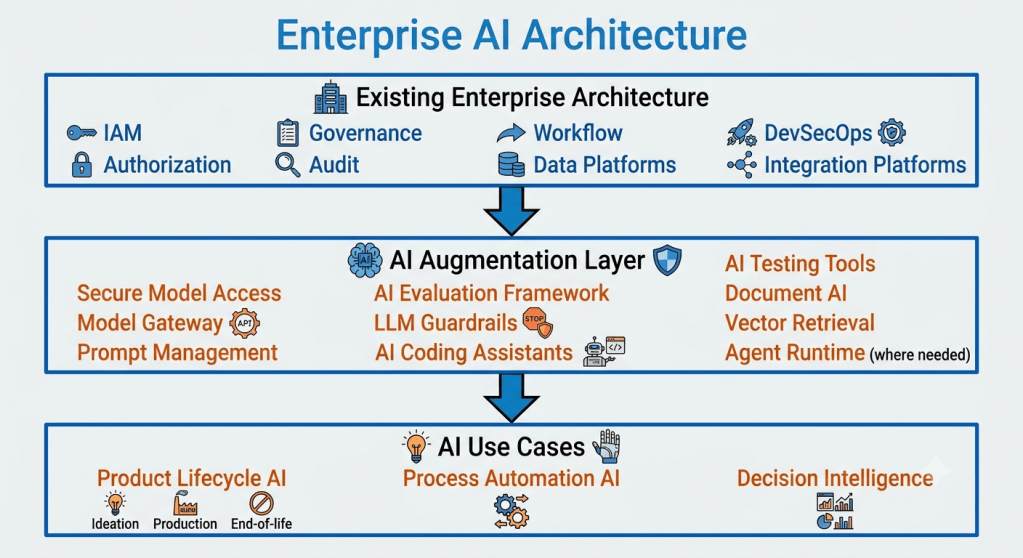
Most Enterprise AI Architecture discussions begin with agents, MCP, vector databases, and knowledge graphs. A more practical approach is to start with the business outcomes enterprises are trying to achieve and identify the small set of new capabilities required to augment existing enterprise architecture.
The Problem with Most AI Architecture Diagrams
Spend ten minutes browsing Enterprise AI Architecture diagrams and a pattern quickly emerges.
The diagrams are filled with agents, MCP servers, vector databases, knowledge graphs, orchestration frameworks, and autonomous workflows.
What is often missing is a simple question:
What business problem is the architecture trying to solve?
Most discussions about AI automation quickly converge on agents. The reality is that enterprises automate work in very different ways depending on where the process resides. Understanding those patterns is often more important than choosing the latest AI framework.
Process Automation AI Starts with the Process
One of the recurring themes in enterprise architecture is that technology choices should follow business context.
Process Automation AI is no different.
The most important question is not:
Which agent framework should we use?
It is:
Where does the process live today?
The answer to that question often determines the architecture, technology choices, governance requirements, and operating model that follow.
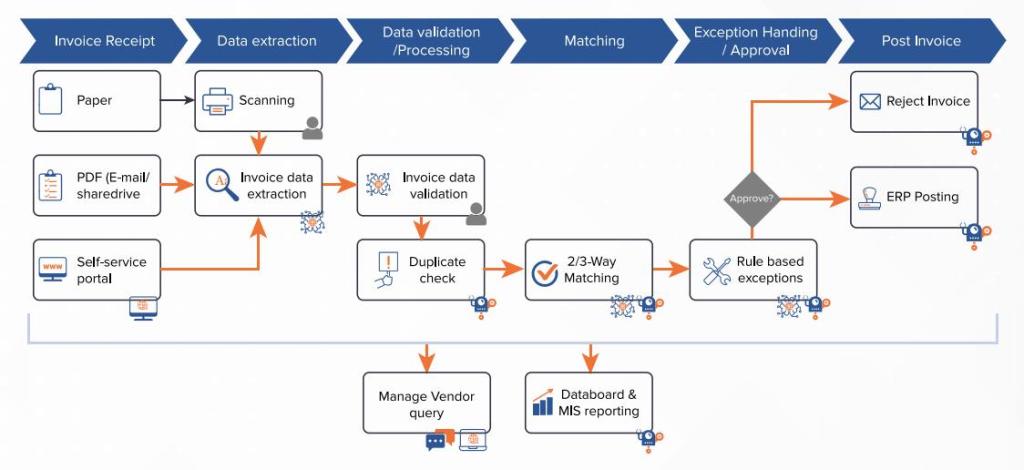
A customer service workflow inside ServiceNow is not the same problem as claims processing in a strategic application. Neither resembles an invoice workflow spanning email, ERP systems, approval processes, and vendor communications.
Yet many AI automation discussions treat them as variations of the same problem and immediately jump to agents, orchestration frameworks, and autonomous workflows.
In practice, enterprises encounter three distinct automation patterns, each requiring a different architectural approach.
The Three Process Automation Patterns
Pattern
Where the Process Lives
Typical Examples
SaaS-Native AI
SaaS Platforms
CRM, ITSM, ERP, HR
AI-Enabled Strategic Applications
Core Business Applications
Claims, Underwriting, Supply Chain, Industry Platforms
Cross-System Automation
Multiple Systems
Invoice Processing, Onboarding, Order Fulfillment
The most important architectural question is often not which AI technology to use.
It is:
Where does the process live today?
Pattern 1: SaaS-Native AI
When a process already lives inside a SaaS platform, the most practical approach is often to leverage the AI capabilities provided by that platform.
Examples include:
Salesforce
ServiceNow
SAP
Workday
Microsoft Dynamics
Capabilities range from summarization and recommendations to workflow execution and task automation.
Many vendors now market these capabilities as copilots, assistants, or agents. From an enterprise architecture perspective, these distinctions are less important than the underlying principle.
The process already exists inside the platform.
The AI capability is simply an extension of that platform.
Architecture Principle
Start with the AI capabilities already embedded in the platform before building custom solutions.
For many enterprises, this will be the fastest path to realizing value from AI.
Pattern 2: AI-Enabled Strategic Applications
Many of the most important enterprise processes do not live inside SaaS platforms.
They live inside strategic applications built and maintained by the organization over many years.
Examples include:
Claims processing systems
Underwriting platforms
Supply chain applications
Customer operations systems
Industry-specific operational platforms
Legacy systems supporting core business processes
These applications often contain decades of business logic, process knowledge, integrations, and organizational expertise.
Replacing them is rarely practical.
Instead, AI provides an opportunity to modernize the user experience while preserving the underlying business capabilities.
This typically occurs in two stages.
Stage 1: Understanding the Application
Many organizations struggle with applications that have evolved over years and are poorly documented.
AI can help reverse engineer:
Business rules
Process flows
Data relationships
User journeys
System dependencies
This creates a foundation for modernization.
Stage 2: AI-Enabled Experiences
Once the application context is understood, AI can be embedded directly into the workflow.
Examples include:
Process guidance
Rule interpretation
Case summarization
Form completion
Next-best-action recommendations
Contextual knowledge retrieval
The objective is not to replace the application.
The objective is to reduce cognitive load, reduce navigation complexity, reduce the number of user interactions, and present information in a more meaningful way.
A claims processor may no longer need to navigate five screens to understand a case. The AI can assemble and present the relevant information within the context of the task being performed.
Architecture Principle
Preserve the business process and underlying application while using AI to simplify how users interact with it.
What Is New?
Existing Capability
AI Augmentation
Strategic Applications
Reverse Engineering, Process Discovery, Summarization, Recommendations, Workflow Guidance, Conversational Interfaces
For many organizations, this may represent one of the highest-value AI opportunities because it improves productivity within the systems employees use every day without requiring a major application replacement program.
Pattern 3: Cross-System Automation
This is where many of today’s AI architecture discussions originate.
The process spans multiple systems and often begins with a document, email, event, or request.
A typical workflow might look like:
The challenge is coordinating work across systems.
This is where many of today’s AI buzzwords begin to appear:
Agent runtimes
Workflow orchestration
RPA
Tool access layers
MCP
Human approvals
Exception handling
However, focusing on the technology often obscures the actual problem.
The objective is not to maximize autonomy.
The objective is to automate work safely across enterprise systems.
Architecture Principle
Focus on orchestrating work across systems rather than building autonomous agents.
What Is New?
Existing Capability
AI Augmentation
Workflow Engines
LLM Reasoning
BPM Platforms
Document Understanding
RPA
Agent Runtime
APIs
Tool Access Layer
Human Approvals
Confidence-Based Routing
Unlike SaaS-native AI and AI-enabled strategic applications, cross-system automation introduces a new challenge: coordinating work across documents, workflows, APIs, enterprise applications, and people.
This is where concepts such as workflow orchestration, agent runtimes, RPA, tool access, and governance begin to matter.
We’ll explore these architectural considerations in the next article when we take a deeper look at Enterprise Agentic Architecture.
Bottom Line
Most enterprise process automation discussions begin with agents.
A better place to start is the process itself.
Enterprise automation generally falls into three patterns:
SaaS-Native AI
AI-Enabled Strategic Applications
Cross-System Automation
The first pattern leverages AI capabilities embedded within SaaS platforms.
The second modernizes strategic applications by helping users navigate complexity and interact with decades of accumulated business logic more effectively.
The third introduces a more significant architectural challenge: coordinating work across systems, workflows, documents, APIs, and people.
The challenge is not choosing an agent framework.
It is understanding where the process resides and applying the right automation pattern to create business value.
Once that decision is made, the architecture becomes much clearer.
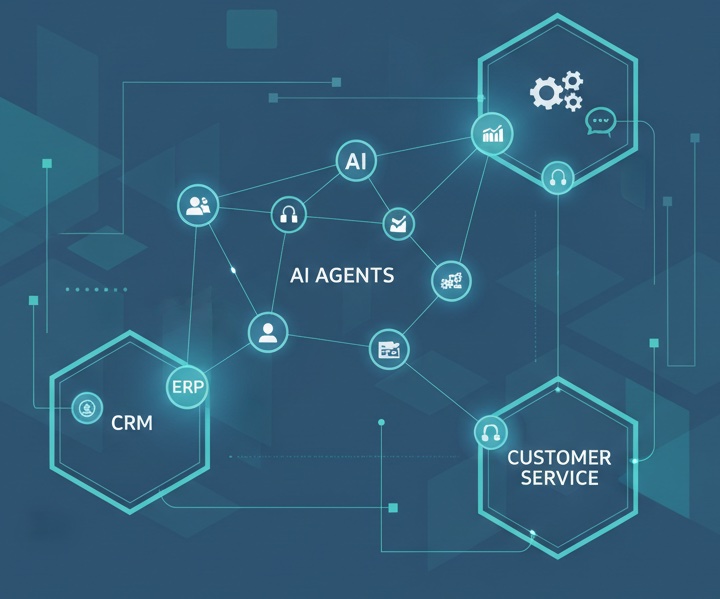
In the previous article, I described Cross-System Automation as the most transformative pattern of Process Automation AI. Unlike SaaS-native AI or AI-enabled strategic applications, cross-system automation requires AI to coordinate work across applications, documents, workflows, APIs, and people. This is where Agentic Architecture begins.
Much of the current discussion around Agentic Architecture focuses on technology. Teams debate MCP, LangGraph, Semantic Kernel, orchestration engines, and multi-agent systems. Vendors promote competing visions of how agents should be built and deployed.
These technologies matter, but they are implementation choices.
The more important architectural question is:
How should an enterprise realize Agentic Architecture?
In practice, the answer has less to do with frameworks and protocols and more to do with ownership.
Who owns the experience?
Who builds the capability?
Who provides the platform?
Who owns the business outcome?
These decisions ultimately shape the architecture far more than any individual technology selection.
Agentic Architecture Is an Operating Model Decision
Most enterprise architecture discussions begin with technology. Agentic Architecture is different.
The moment AI starts coordinating work across systems, architecture and operating model become tightly coupled.
A customer service agent may access CRM data, knowledge articles, ticketing systems, workflow engines, and enterprise APIs. A procurement agent may coordinate contracts, approvals, supplier information, ERP transactions, and email communications.
At this point, the challenge is no longer connecting systems.
The challenge is determining how responsibilities are divided across the enterprise.
Organizations that approach Agentic Architecture purely as a technology initiative often find themselves debating frameworks before they have defined ownership.
The organizations that move fastest typically establish an operating model first and then select technologies that support it.
Decision 1: Who Owns the Experience?
One of the first architectural decisions is determining where users interact with agents.
The natural temptation is to build a centralized AI experience. An enterprise assistant. A unified portal. A single destination for every automation initiative.
Most business processes already have a natural home.
Sales teams operate within Salesforce.
Customer service teams operate within ServiceNow.
Finance teams work inside ERP systems.
Operational teams often have their own industry-specific platforms.
Even when a workflow spans multiple systems, users typically interact through a single anchor application.
This creates an important principle for Agentic Architecture.
The agent may operate across systems.
The experience should remain close to the process owner.
A procurement agent may coordinate activities across contracts, supplier systems, approvals, and ERP platforms. The procurement professional should continue working within the procurement experience they already understand.
The recommendation is straightforward:
Domain teams should own experiences.
Platform teams should provide the capabilities that enable those experiences.
This approach allows AI adoption to scale without requiring a centralized team to build every interaction model across the enterprise.
Decision 2: Who Builds Agentic Capabilities?
The next decision is determining how agentic capabilities will be realized.
Most enterprises will adopt a combination of three approaches.
The first is leveraging agentic capabilities already embedded within enterprise platforms. Salesforce, ServiceNow, SAP, Workday, Microsoft, and other vendors are increasingly providing agentic functionality as part of their products. When a process largely resides within a platform, vendor-provided capabilities are often the most pragmatic option.
The second approach is adopting an automation platform. Solutions such as UiPath, Automation Anywhere, Camunda, Microsoft Power Platform, and Pega are evolving into agent-enabled orchestration platforms capable of coordinating work across multiple systems. These platforms are increasingly becoming the default choice for common cross-system workflows.
The third approach is building custom agentic capabilities.
This is where most architectural decisions emerge.
The first question is whether the workflow actually requires an agent. Some processes are largely deterministic and benefit from workflow orchestration with AI embedded at specific steps. Others require dynamic reasoning, planning, tool selection, and adaptation to changing conditions.
The second question is whether a single agent is sufficient or whether multiple specialized agents are required.
Most enterprise implementations begin with a single orchestrating agent responsible for coordinating tools and workflows. Multi-agent architectures become relevant when responsibilities need to be separated across planning, research, execution, compliance review, or quality assurance.
The third question is selecting a runtime.
Organizations building custom capabilities are increasingly standardizing on frameworks such as LangGraph, Semantic Kernel, OpenAI SDKs, and similar orchestration technologies.
The framework itself is rarely the most important decision.
The more important decision is establishing runtime standards that domain teams can build upon.
This includes:
Deployment patterns
Security controls
Evaluation frameworks
Observability standards
Runtime lifecycle management
The objective is not creating one team that builds every agent.
The objective is creating a platform that enables many teams to build safely and consistently.
Decision 3: How Do Agents Access Enterprise Capabilities?
No topic generates more discussion today than MCP.
Many organizations encounter MCP and immediately begin asking how enterprise applications should be exposed to agents.
A more useful question is:
What capabilities should agents consume?
Most enterprise applications expose technical operations.
Agents require business operations.
A customer service agent should retrieve customer information, create service cases, and update accounts.
A procurement agent should approve invoices, retrieve contracts, validate suppliers, and create purchase orders.
These capabilities eventually become enterprise tools.
Over time, organizations discover that the same capabilities are used repeatedly across multiple workflows and domains.
Customer lookup.
Contract retrieval.
Policy interpretation.
Document classification.
Inventory validation.
Invoice approval.
This is where capability catalogs become important.
Once capabilities have been defined, they can be exposed through APIs, integration platforms, tool registries, and eventually MCP.
The sequence matters.
Capabilities first.
Standardization mechanisms second.
Decision 4: How Should Enterprise Information Be Exposed?
As agents become more capable, access to information becomes increasingly important.
The key architectural decision is determining how information is exposed.
Not every agent requires access to enterprise-wide knowledge.
Most agents require information specific to the business process they support.
An invoice approval agent may need contracts, purchase orders, supplier information, and approval policies.
A customer service agent may need customer history, knowledge articles, service policies, and open tickets.
Organizations generally have three architectural options.
The first is application-centric access, where agents retrieve information directly from the systems that own the process.
The second is domain-centric access, where information is assembled into reusable domain data products that support multiple workflows and applications.
The third is an enterprise knowledge layer, where information from across the organization is unified and exposed through a common access layer.
For most Agentic Architecture initiatives, application-centric and domain-centric approaches are sufficient.
Enterprise knowledge layers become increasingly important as organizations move toward decision intelligence, enterprise search, and enterprise-wide reasoning.
The architectural objective is simple:
Provide agents with the information required to perform a business task.
Not every piece of information available across the enterprise.
Decision 5: How Will the Enterprise Scale?
This is ultimately the most important decision.
Most organizations focus on building the first agent.
The more important question is:
How will the fiftieth agent be built?
This is where operating model becomes more important than technology.
The responsibility of the platform team is not to build agents.
The responsibility of the platform team is to create the paved road.
That paved road includes:
Model access
Runtime standards
Governance
Guardrails
Tool catalogs
Evaluation frameworks
Identity and authorization
Observability
These capabilities should be built once and reused many times.
Business domains then build outcomes on top of those capabilities.
This creates a scalable model where multiple teams can innovate simultaneously without competing for the same central delivery organization.
Over time, organizations may introduce additional capabilities such as reusable services, agent registries, agent templates, and low-code development experiences.
These investments become valuable because the underlying platform standards already exist.
The result is a clear separation of responsibilities.
Platform teams provide capabilities.
Business domains provide outcomes.
Reusable Agents or Discoverable Patterns?
Another concept gaining attention is the idea of agent registries, agent marketplaces, and Agent-to-Agent (A2A) communication. The vision is straightforward: organizations build specialized agents that can be discovered, composed, and reused across multiple business processes.
The idea is compelling, but enterprises should be careful about assuming enterprise-wide reuse.
Enterprise architecture has seen similar aspirations before.
API programs demonstrated that standard interfaces can dramatically accelerate software development. Technology companies and digital-native organizations have successfully built platforms where services and APIs are reused extensively across products and engineering teams.
Large enterprises, however, often operate very differently.
Business capabilities evolve independently across divisions, regions, acquisitions, and product lines. A “customer” means different things to retail banking, commercial banking, insurance, and wealth management. An “invoice approval” process may vary by geography, business unit, regulatory requirements, or operating model.
The challenge is rarely technical.
It is semantic.
As a result, organizations often discover that complete enterprise-wide reuse is less valuable than originally anticipated. Teams extend existing capabilities, adapt them to their own business context, or build variations that better reflect local operating models.
The same principle applies to agents.
Most enterprise agents are closely aligned to business workflows, policies, user experiences, and domain context. Rather than expecting agents to become universally reusable, organizations should expect them to evolve within individual business domains.
This does not diminish the value of agent registries.
Their primary purpose should be discoverability rather than maximizing reuse.
An agent registry allows teams to understand what already exists, identify implementation patterns, discover enterprise tools, and determine whether an existing solution can be extended before creating another one.
The platform team’s role is therefore not to maximize reuse.
It is to reduce unnecessary reinvention while establishing consistent runtime standards, governance, identity, observability, and engineering practices.
That distinction aligns closely with the broader operating model for Enterprise Agentic Architecture.
Standardize the platform. Enable business autonomy.
A Final Thought
Agentic Architecture is often described as a collection of frameworks, protocols, orchestration engines, and AI runtimes.
In practice, it is a set of architectural decisions about ownership.
Who owns the experience?
Who builds the capability?
Who exposes enterprise services?
Who provides information access?
Who owns the outcome?
The answers to these questions shape the architecture far more than any individual technology selection.
The organizations that realize the most value from Agentic Architecture will not necessarily be the ones with the most sophisticated agent framework.
They will be the ones that establish a scalable operating model that allows business domains to innovate while relying on a common set of enterprise capabilities.
The principle is simple:
Centralize capabilities. Decentralize outcomes.
Platform teams provide the foundation.
Business domains provide the innovation.
That operating model, more than any framework or protocol, is what ultimately enables Agentic Architecture to scale across the enterprise.
Software engineering principles are not timeless truths. They are economic optimizations.
For decades, the dominant constraint was the cost of implementing software. Writing, testing, integrating, and maintaining systems required significant time and specialized expertise. Many of the practices we now consider foundational — reuse, abstraction, shared services, centralized architecture, and specialized engineering teams — emerged because they reduced the cost of producing software.
Artificial intelligence changes that equation. Fred Brooks distinguished between accidental complexity — the effort required to implement software — and essential complexity — the inherent complexity of the business problem. AI dramatically reduces accidental complexity while leaving essential complexity largely unchanged.
Kent Beck describes this trend as Programming Deflation: implementation becomes progressively less scarce. Just as we no longer optimize applications around minimizing CPU instructions because hardware became abundant, we will increasingly stop optimizing organizations around minimizing implementation effort.
When implementation is no longer the dominant constraint, software engineering should stop optimizing for implementation efficiency. The new constraint is organizational learning velocity.
If the economics have changed, our engineering heuristics should change with them.
Treat Coordination as a First-Class Engineering Cost
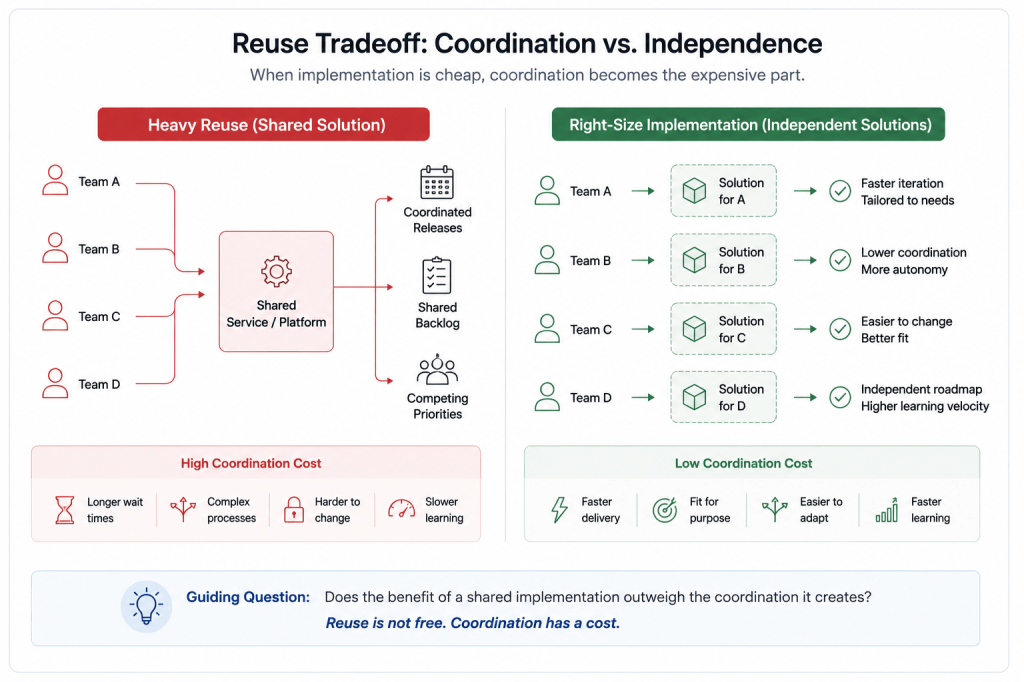
For decades, reuse was considered an engineering virtue because implementation was expensive. Building something once and sharing it across the enterprise was almost always cheaper than building it many times.
AI changes that tradeoff. Generating another implementation is increasingly inexpensive. Coordinating around a shared implementation is not.
Every shared implementation introduces hidden costs: shared ownership, generalized requirements, competing priorities, synchronized releases, architectural compromise, and organizational dependencies. Those costs were justified when implementation dominated the economics. As implementation becomes cheaper, coordination increasingly becomes the larger cost.
A Practical Example
Consider a familiar enterprise scenario: four product teams each need to extract information from different document types. Historically, the obvious answer would have been to build a shared OCR platform because implementing OCR was expensive.
Today, each team may only need a single LLM call with prompts and evaluation criteria tailored to its documents and business rules. Building four independent implementations may require less effort than designing, governing, and evolving a single shared service that satisfies everyone.
The implementation is no longer the expensive part. Coordinating the shared implementation is.
This doesn’t mean reuse disappears. Enterprise capabilities such as identity, networking, security, compliance, and observability still benefit from central ownership because consistency reduces organizational risk. But business capabilities should no longer be centralized simply because they could be reused.
The question is no longer, “Can this be reused?” It is, “Does the value of a shared implementation outweigh the coordination it creates?”
Put Organizational Learning Closest to the Customer
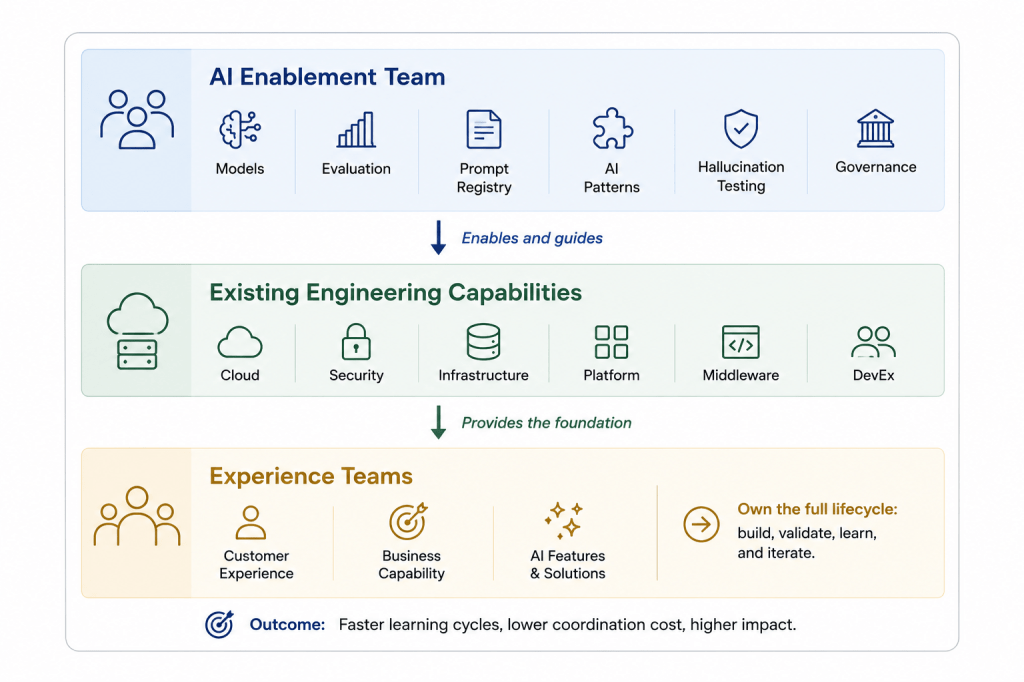
If organizational learning velocity is the new constraint, then the teams closest to customers should own business capabilities.
Many organizations still separate customer understanding from implementation. Experience teams identify opportunities while centralized engineering organizations build reusable services and shared solutions. Every organizational handoff slows the cycle between customer insight, implementation, validation, and the next iteration.
AI removes much of the implementation friction that originally justified those handoffs. Experience teams should increasingly own the complete lifecycle of their capabilities — from understanding the business problem and implementing the solution to validating outcomes and iterating based on customer feedback. The objective is not decentralization for its own sake. It is shortening the organizational learning loop.
When AI Reasoning Belongs in the Domain
Consider a scheduling application. AI can explain why a schedule violates business constraints, recommend alternative schedules, analyze the implementation to identify unnecessary complexity, and propose changes that preserve business intent.
That intelligence is tightly coupled to the business capability and evolves with it. Extracting that reasoning into a centralized AI service introduces another organizational dependency. Every enhancement to the scheduling logic must now be generalized, prioritized, and coordinated across teams. What appears to be AI reuse is often just business logic moved further away from the domain that understands it best.
What appears to be AI reuse is often just business logic moved further away from the domain that understands it best.
Enable AI Adoption — Don’t Create Another Bottleneck
One common response to AI is to create another centralized implementation organization. While this can accelerate early adoption, it often becomes the next organizational bottleneck.
Every major technology shift has produced a new Center of Excellence. Initially these groups accelerate adoption. Eventually they become delivery bottlenecks because every initiative depends on them.
Organizations absolutely need AI expertise. They do not need every AI initiative to require AI specialists.
Ordinary Engineering, Extraordinary Outcomes
There is an important distinction between using AI and advancing AI.
Many business capabilities now require nothing more than integrating an LLM into an application, defining prompts, providing context, and validating results. These are rapidly becoming ordinary software engineering activities. Requiring a specialized AI team to participate in every implementation simply recreates the implementation bottleneck that Programming Deflation is eliminating.
Specialized expertise remains essential where it creates enterprise leverage: model evaluation, governance, security, safety, reusable patterns, cost optimization, and operational excellence. The purpose of AI specialists should be to make every engineering team more effective — not to become a mandatory dependency for every project.
Organizations should also resist rebuilding capabilities they already possess. Cloud engineering, infrastructure, networking, security, platform engineering, and developer experience teams already know how to deploy, secure, operate, integrate, and govern software at scale. AI should extend these capabilities rather than duplicate them in a new AI organization.
The goal of AI expertise should be to eliminate organizational dependencies, not create them — to make AI an ordinary part of software engineering rather than a specialized organizational dependency.
A Different Optimization
These heuristics are not replacements for sound engineering principles. They are guidance for deciding where centralization still creates leverage — and where it primarily creates coordination cost.
The organizations that succeed in the AI era will not necessarily be those that generate software most efficiently. They will be those that learn the fastest — those that reduce the time between an idea, customer validation, and the next iteration.
Before introducing another abstraction, shared service, architecture review, or centralized team, ask:
Does this reduce the cost of coordination or increase it?
Does this shorten the organizational learning loop or lengthen it?
Does this enable teams or create another dependency?
Does this automate governance or institutionalize waiting?
The answers to those questions will increasingly determine the effectiveness of software engineering in the age of AI.
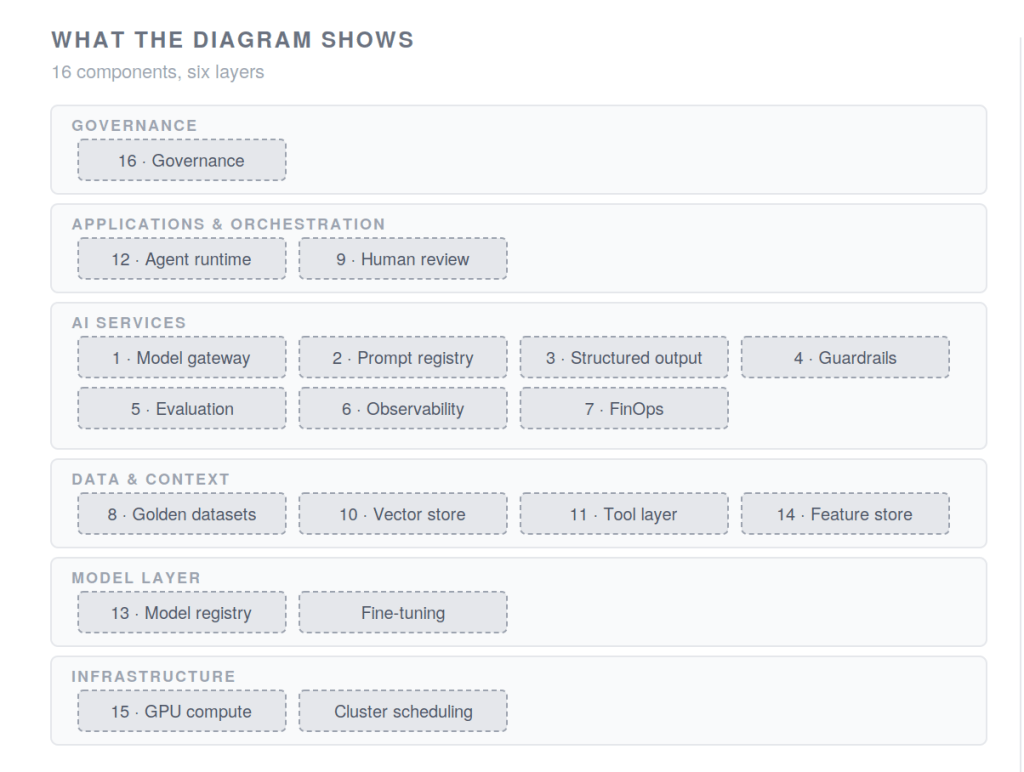
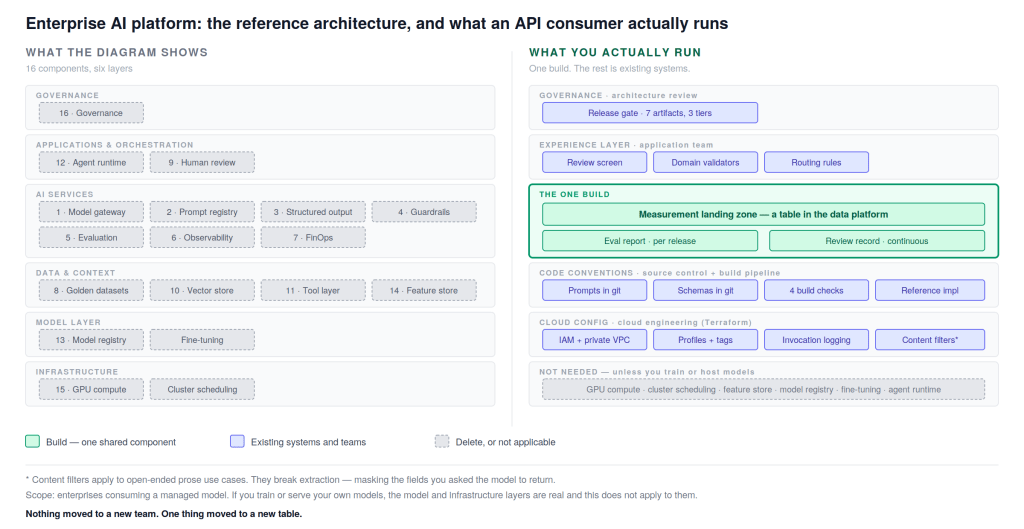
Most AI platform discussions begin with a sixteen-component stack: gateways, prompt registries, vector databases, agent runtimes, evaluation platforms. A more practical approach is to take each component apart against real enterprise work and ask what it actually reduces to. Do that, and one turns out to be genuine infrastructure. Most of the rest is work the enterprise already does under an unfamiliar name.
This article tests that claim component by component. Each one is pushed down to the level of what somebody actually types, configures, or signs.
One test applies to every component: would the second use case otherwise rebuild it? If not, it is not a platform component.
A secondary test catches a great deal. If a capability behaves the same regardless of which hosting channel or programming language you use, it is not yours. It comes from the model, and no platform layer is providing it.
Five use cases, chosen for different data classes, output shapes, and consequences of being wrong.
Use case
Shape
Where the output goes
Referral intake
Document to structured fields
Internal system, confirmed by staff
Invoice intake
Email attachment to an ERP write
Financial system
Payment variance
Structured lookups to ranked reasons
Staff decision
Policy Q&A
Retrieval to a prose answer
Staff, advisory only
Care task recommendation
Patient context to a suggested task list
Clinician
A capability list is not an architecture. It becomes one only when each item resolves to a decision, an owner, and a cost.
The Scorecard, in Four Groups
The sixteen do not fail in sixteen different ways. They fail in four, and each group is examined in its own article.
Group one — the model call. Everything surrounding a single request to the model.
Component
What it actually is
Model access / gateway
Real — cloud configuration, owned by cloud engineering
Prompt management
Source control, plus one build check
Structured output
One request parameter and a schema file
Guardrails
Four unrelated things: one config, one validator, one written rule
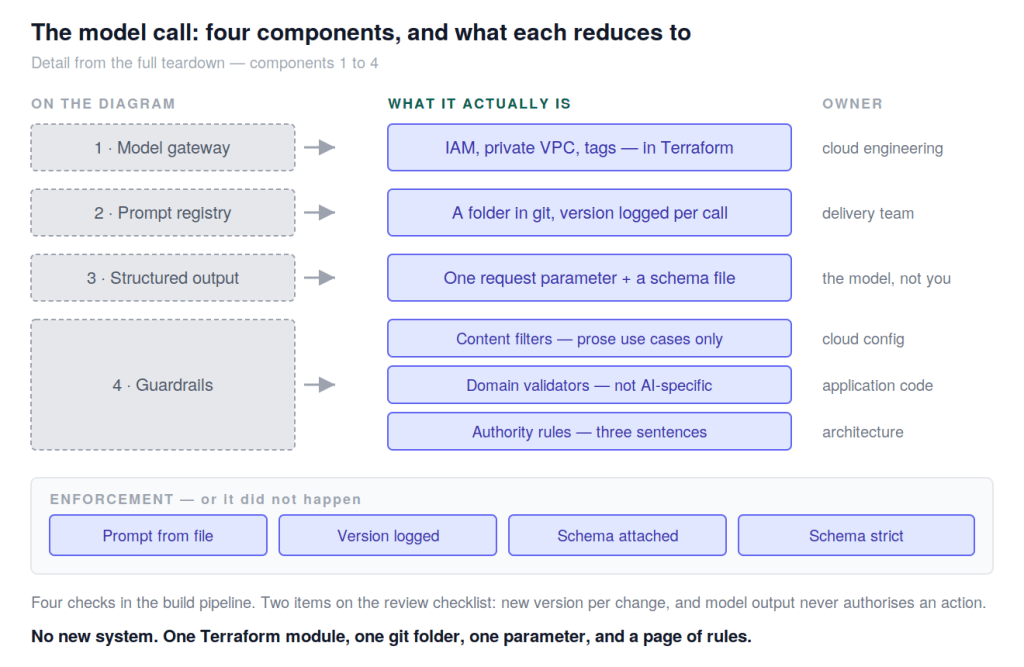
A Terraform module, a folder in source control, one parameter, and a page of rules.
Group two — the quality bar. How you know the output is any good.
Component
What it actually is
Evaluation
Real requirement — a few hundred lines, expensive in expert time
Observability
Existing logs, one naming convention, one join
Golden datasets
Existing records plus two days of labeling
Human review
An application screen — but see what it produces
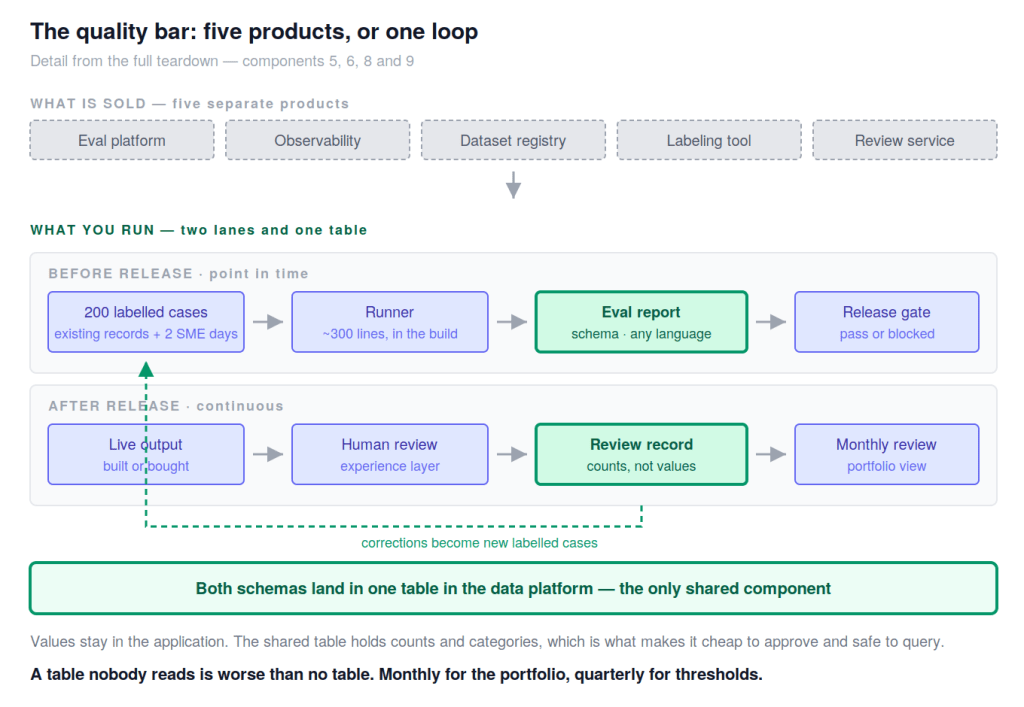
The only genuine gap in the sixteen, and the only place a new shared component survives.
Group three — already yours, or never yours. Layers that are features of software you run, or infrastructure for a problem you do not have.
Component
What it actually is
Retrieval / vector store
A feature of the database you already run
Tool and context layer
Integration work, owned by the integration team
Agent orchestration
A function for single-domain work; real for cross-system automation
Model registry
Real only if you train models
Feature store
Real only if you train models
GPU infrastructure
Real only if you host models
Six layers, none of which needs procuring.
Group four — the gate and the buy side. What you require of anything before it reaches production, built or bought.
Component
What it actually is
Cost management
Existing cloud tooling, one metric definition
Governance and risk
Seven artifacts, three tiers, forums you already run
Most of your AI portfolio will arrive inside software you bought, where none of groups one to three reaches.
One infrastructure item across sixteen components. It is Terraform, and cloud engineering already owns that skill.
The Same Picture, Twice
Read the right panel by who owns each band. Cloud engineering owns the configuration. The application team owns validators, routing, and the review screen. Architecture review owns the gate.
Nothing moved to a new team. One thing moved to a new table.
What Actually Survives
One shared component: a place where measurement lands.
The review screen belongs to each application. What every capability produces is the same — a stream of records saying a person looked at this output and accepted it, corrected this field, or rejected it for this reason.
Collect that centrally and the enterprise can answer three questions it currently cannot. Is our AI getting better or worse? What share of it now runs without a person confirming? Which capability is drifting toward a threshold nobody agreed to move?
In most enterprises this is a table in the data platform, not a service. And it carries the fact of a correction, not its content — values stay in the application, which keeps the shared tier low-classification and cheap to approve.
Two schemas feed it. An evaluation report, published before release. A review record, continuous after it. Both are language-agnostic by design, because a team working inside a purchased product can produce them from an export.
Beyond that: four build checks, one reference implementation per stack, and one number captured before go-live — the manual baseline you cannot reconstruct later.
That is the platform.
The One Thing Nobody Owns
Traditional testing asks whether the same input produces the same output. These systems are not built that way. A system can pass every test your organization runs today and still be wrong a third of the time.
Nobody currently owns the question of whether it is good enough. Not QA, which tests determinism. Not the delivery team, which will not impose a gate on itself. Not procurement, which does not know to ask. Not the model risk function, which was built for statistical models and has no view on generated text.
The platform is not a stack. It is a table, two schemas, and a gate.
That is the finding. Not a missing tool — a missing accountability.
Where the Diagrams Come From
The transmission is worth naming, because each step is rational and the output is not.
AI labs and infrastructure vendors publish architectures reflecting their own problem: training, serving, and scaling models. Tool vendors extend the diagram, because every layer is a product. Consultancies package it as a reference architecture. Enterprise architects inherit a stack built for model builders.
The usual critique of vendor content is that it underestimates enterprise complexity. Here it is the reverse. An enterprise consuming a managed model has a simpler problem than the diagram implies, and adopts the complexity anyway — because that is what the diagram showed.
Bloat from imported sophistication, not from underestimated difficulty.
What This Does Not Cover
This holds for enterprises that are largely consumers of purchased software, with a thin slice of custom development and an existing data platform.
If you train and serve models, components 13 to 15 are real and this argument does not apply to them. The trouble is that most diagrams conflate the predictive and generative stacks, so an organization running one risk model inherits the infrastructure requirements of both.
This series is also grounded in process automation. Decision intelligence is a different answer, and it is where a lakehouse, retrieval, and a semantic layer genuinely become architectural capabilities rather than optional enhancements.
The failure is not that any single diagram is wrong. It is applying one diagram to three different classes of work.
Most AI platform programs begin by adopting a capability list and staffing a team against it.
The list is not wrong. It is simply not an architecture until each item has been resolved to a decision, an owner, and a cost. Do that work and the stack collapses. What remains is a table, two schemas, a small set of build checks, and someone accountable for the quality bar.
Model gateway, prompt registry, structured output layer, guardrails. Four boxes on every AI architecture diagram, and the first two quarters of most AI platform programs. For an enterprise consuming a managed model, they reduce to a Terraform module, a folder in source control, one request parameter, and a function you were going to write anyway.
Access Is Real, and It Belongs to Cloud Engineering
This is the one component in the group with genuine infrastructure behind it, and your cloud team already knows how to build it.
A managed model service provides the whole capability natively: an IAM role per workload, inference profiles carrying cost allocation tags, invocation logging, private network paths, and the contractual coverage regulated data requires.
A proxy in front of it is redundant unless you are genuinely running two cloud providers’ model services. It also places a platform team in the path of every inference call, which is an availability problem you created for yourself.
Three traps default to wrong.
Invocation logs contain your raw data. For a referral, that is the patient name and member ID sitting in a log bucket. Classification, encryption, and retention are decisions somebody has to make, and nobody makes them by default.
The document extraction vendor sits upstream. Your model call may be compliant while the OCR step in front of it is not.
Endpoint compliance is not pipeline compliance. The model call is one hop.
Source Control Is the Prompt Registry
Prompt management products offer versioning, diff, authorship, approval, and rollback. Your source control already provides all five.
Four rules, and no new system:
The prompt lives in a file, never as a string inside code
The output schema is versioned in the same folder and changes with it
A released prompt is never edited — a change means a new version
The version string is derived from the filename and logged on every call
The audit question is: for this record, what prompt produced this output, who approved it, and when did it change? Three systems you already run answer it. The application log holds record to version. Source control holds version to diff and approver. The invocation log holds the actual request.
A registry earns its place when a non-engineer needs to edit prompts, or when discovery across dozens of them becomes real. Neither applies to one team and one use case.
And runtime prompt swapping is a feature to refuse in a regulated path. An unreviewed prompt change reaching production without passing your build checks is precisely what you are trying to prevent.
Structured Output Comes from the Model
You attach a schema to the request and the model is constrained to fill it. It works identically whichever hosting channel you use — which is exactly why it does not belong to the platform layer.
The mechanism is free. The schema design is the work.
Every field is an object, not a bare value. A field returns its value, a status, and where in the document it came from. Bare values cannot express “I could not read this,” and you cannot add that later without breaking every consumer.
Status is a required enumeration.Extracted, not present, illegible. On a referral, “not present” means call the referring office and “illegible” means request the fax again. Collapse them into an empty value and the routing decision is destroyed.
Constrain types in the schema. Date patterns, code formats, enumerated values. Every constraint expressed is a class of error the model cannot produce.
Nothing is optional. Force an explicit “not present” rather than a silently missing field. An absent field and an absent value are different failures, and only one is recoverable.
Then validate the response against the schema anyway. Constrained generation is very good, not guaranteed.
AI output crossing a system boundary is a versioned contract. Teams skip the discipline because model output feels like text.
Guardrail products are built for chat and retrieval — open-ended input, prose output, human reader. They fit a staff-facing policy assistant well.
They are useless or harmful for extraction. The marquee feature is PII filtering, which on a referral would mask the patient name and member ID you asked the model to extract. Mandating that every AI call passes through the guardrail service would break your highest-value use case.
And domain validation is not AI work. Checking that a diagnosis code is active or an invoice’s line items sum to the total belongs on human-entered data too. Build it as shared intake validation used by both paths, and it stops being an AI platform component at all.
The Rules Worth Writing Down
Three, and they cost nothing to state.
Model output never authorizes an action. Validation passing does. Confidence is advisory and only orders the review queue.
Tools available to a model reading untrusted input are read-only. An incoming fax or invoice is untrusted input.
Anything leaving the organization gets human sign-off.
Most teams already do all three by accident. Writing them down is what makes the next team inherit them.
Enforcement, or It Did Not Happen
Publishing principles does not work. Nobody reads them and there is no consequence.
Every convention needs exactly one of: an automatic check, an item on the review checklist, or a gate before release. If it has none, it is a document.
Think of the clerk at the passport office. She does not read your application or judge whether you deserve a passport. She checks that the photo is attached, the form is signed, and the fee is paid. Four seconds, and it catches the mistake that would otherwise surface six weeks later.
Convention
Enforced by
Prompt in a file, version logged
Automatic check
Schema attached and strict
Automatic check
New version per change, never edit
Review checklist
Model output does not authorize action
Review checklist
Accuracy report published
Release gate
Five conventions, and only two need a human. That ratio is what makes a standard survive after you stop watching.
A standard with no mechanism behind it is a wiki page, not a standard.
Final Thoughts
Four components. One Terraform module, one folder in source control, one request parameter, and a page of rules.
No new system, no new team, and nothing here an enterprise does not already know how to do. What is left is discipline — and discipline only holds when something mechanical enforces it.
Traditional testing asks whether the same input produces the same output. A probabilistic system passes every test your organization runs today and can still be wrong a third of the time. This is the one genuine gap across sixteen marketed AI platform components — and the software is a few hundred lines. What it costs is expert time and a decision nobody has made.
Every component so far has dissolved into an existing system. This one does not.
Four Outcomes, Not Two
Traditional testing has pass and fail. Extraction has four, and collapsing them hides everything.
The system said
The truth was
Outcome
A value
The same value
Correct
A value
A different value
Wrong
“I could not read it”
It was unreadable
Correct abstention
“I could not read it”
It was readable
Over-abstention
A value
It was unreadable
Fabrication
Fabrication and over-abstention have opposite fixes. One needs a stricter instruction, the other a looser one. A single accuracy percentage tells you neither.
So you set three gates, not one. A system at 96% accuracy that never abstains is worse than one at 92% that abstains cleanly — the first fails silently, the second routes to a human.
The key point:
A system that never says “I don’t know” is not accurate. It is confident.
“We Already Have the Data” Is 80% Right
Every enterprise has historic records. Referrals keyed by staff, invoices posted to the ERP. Those give you correct values for free, and they are why this component is cheap.
But they do not tell you where the value came from. The clerk who entered that member ID may have read it off the fax, or pulled it from the patient record after matching, or picked up the phone. All three produce an identical row.
So when your system correctly reports that a field was illegible, the historic record scores it as an error. Tune against that and you are training toward confident invention — the failure you least want.
The fix is two days. Take 200 records and have someone open the source document and mark each field present, absent, or illegible. Not re-keying values, which are already right. Just answering where they came from.
Then it becomes self-sustaining: a reviewer who fills in a field the system marked illegible has just told you it was readable.
A Human in the Loop Does Not Remove the Need
The intuitive objection: if a person confirms every output, the system is just typing with a head start. Why measure it?
Reviewers stop verifying and start confirming. Give someone pre-filled fields and they approve what looks plausible. Well documented in clinical decision support. Approval rates stay high while catch rates quietly fall.
Confidence-gating is the only path to value, and it needs a number. Reviewing everything costs what the manual process cost. The return comes from auto-processing the clean cases, and you cannot responsibly set that threshold without measured per-field accuracy.
Corrections are free labels. Every field a reviewer fixes is a labeled case at zero marginal cost. The review queue is a labeling pipeline that is already running.
And measure the reviewers themselves. Seed a small share of known-bad cases and track the catch rate. If reviewers miss planted errors at 40%, the human control is decorative and your auto-processing threshold is built on sand. Almost nobody does this, and it is cheap.
Sometimes the Business Process Is the Evaluation
Look for this before building anything.
Invoice intake has continuous free ground truth. Three-way match and payment reconciliation tell you, without any labeling, which extractions were wrong. Every invoice that fails to reconcile is a labeled error.
Referrals have a weaker version: eligibility check failures and denials coded to intake data.
Approval is an opinion at the moment of review. The denial is the fact. Where a downstream system will later reveal whether the output was right, name it and carry the key. That signal is bigger, fresher, and cheaper than any dataset you maintain.
When There Is No Correct Answer
Extraction has a right answer. A great deal of enterprise AI does not.
A care task recommendation — suggesting what a clinician should do next for a complex patient — has no ground truth to score. Neither does a summary, or a prioritized worklist. This is the shape most assistant use cases take, and the entire evaluation literature is about the other shape.
The answer is not better measurement. It is constraining the output until measurement becomes possible.
Stop generating. Select instead.
The system does not write tasks. It chooses from a governed catalog of approved tasks, each with defined wording and rationale, owned and versioned by the clinical function that owns the protocol.
Free generation
Selection from a catalog
Is there a right answer?
No
Yes — which tasks should fire
Measurable
Not really
Precision and recall per task
Worst failure
An invented task, unbounded
A wrong or missing selection, bounded
Audit trail
“The system said this”
Task identifier plus the facts that triggered it
Fixing a bad output
Case by case
Retire the catalog entry once
And the dangerous failure inverts. In extraction, invention is what hurts you. In recommendation, omission is — a missing task is invisible to someone skimming a plausible list, while a wrong task gets noticed and removed. Measure omission explicitly, weighted by harm.
The key point:
A schema constrains the shape of the output. A governed catalog constrains its meaning. Both turn “the system said something” into “the system chose from what we approved.”
Buying It
The discipline does not change when the AI arrives inside a purchased product. Only the lever does.
Your vendor can change the model underneath you on a Tuesday with no release note, and you will find out from a billing variance three weeks later.
Run your labeled cases against the vendor during the pilot — not their curated demonstration, but your documents, including the bad ones. Then you are negotiating against a number instead of an impression, and a bake-off between two vendors scores both on the same set.
Then put it in the contract: notification before model changes, an accuracy floor on your acceptance set retested at renewal, the right to evaluate, and export of AI-generated fields with some indication of provenance. Most vendors will not offer these. Some concede several during procurement, and almost none afterward.
The same 200 cases gate your custom code, score vendors in a bake-off, and regression-test the purchased product every quarter. It is the one artifact that survives a build-versus-buy reversal. Enterprises version code and data — almost none version their ground truth.
What Generalizes
Not the runner. Your teams work in Python, Java, .NET, and SaaS configuration, and a shared library serves one of them while the rest bypass it.
What generalizes is two schemas and a place to send them.
The report — point in time, before release. Capability, dataset version, accuracy, fabrication rate, abstention rate, the gates, pass or fail.
The measurement stream — continuous, after release. Which capability, which record, which field, what the model said, what the person did, why, and the key that joins to a downstream outcome.
Send the fact of a correction, not its content. Old and new values are sensitive and stay in the application’s own store. The shared tier holds counts and categories, which is what makes it cheap to approve and safe to query. In most enterprises this is a table in the data platform rather than a service.
A table nobody reads is worse than no table. Four patterns are worth looking for, and only a portfolio view catches them:
Agreement rate declining on a capability — usually the input mix shifted, or a vendor changed a model
Auto-processing rate rising without a threshold review — someone crossed from assisted to autonomous by tuning a number
The same field failing across several capabilities — often one shared cause
Correction rate near zero — not a success, but reviewers who stopped verifying
That last one a single team cannot see; its own approval rate looks like quality.
Monthly for the portfolio, quarterly for thresholds with the business owners who signed them. Not a live dashboard — nobody watches dashboards.
Same pattern as test coverage. Nobody shares a test runner across Java and .NET. Everyone reports a coverage number into the same quality dashboard.
Final Thoughts
This is the only component in sixteen that does not dissolve into something the enterprise already runs. And even here the build is small: a scoring script, two schemas, and a table.
What is expensive is the expert time to say what “correct” means, and the seniority to say a number is not good enough yet. Neither is a technology problem, which is why no platform purchase solves it.
Enterprises buy evaluation platforms and then discover they have nothing to evaluate against.
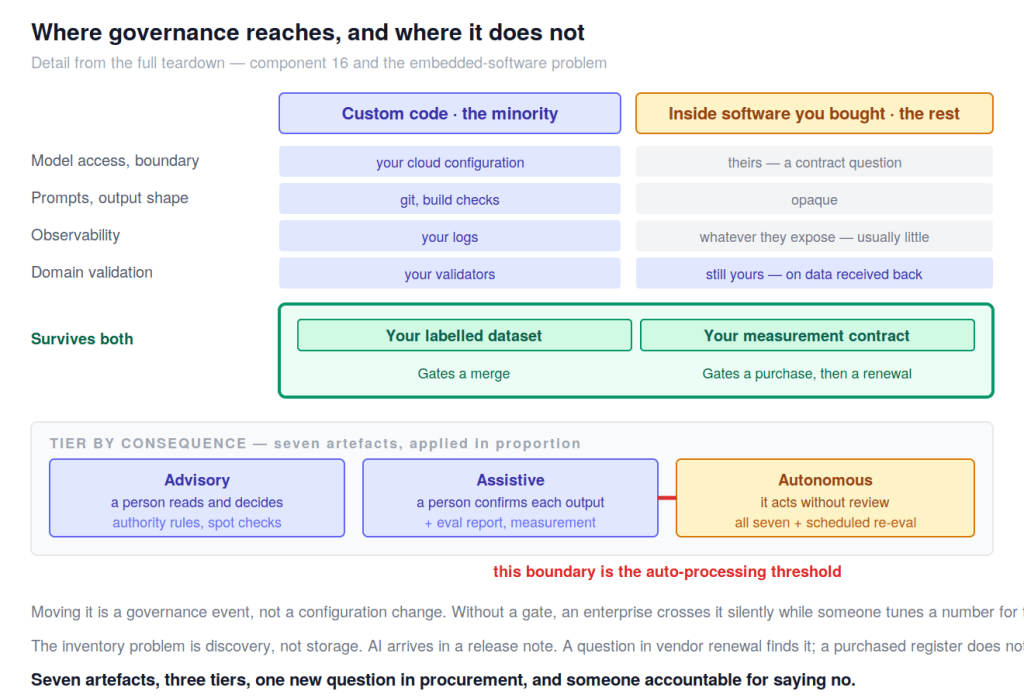
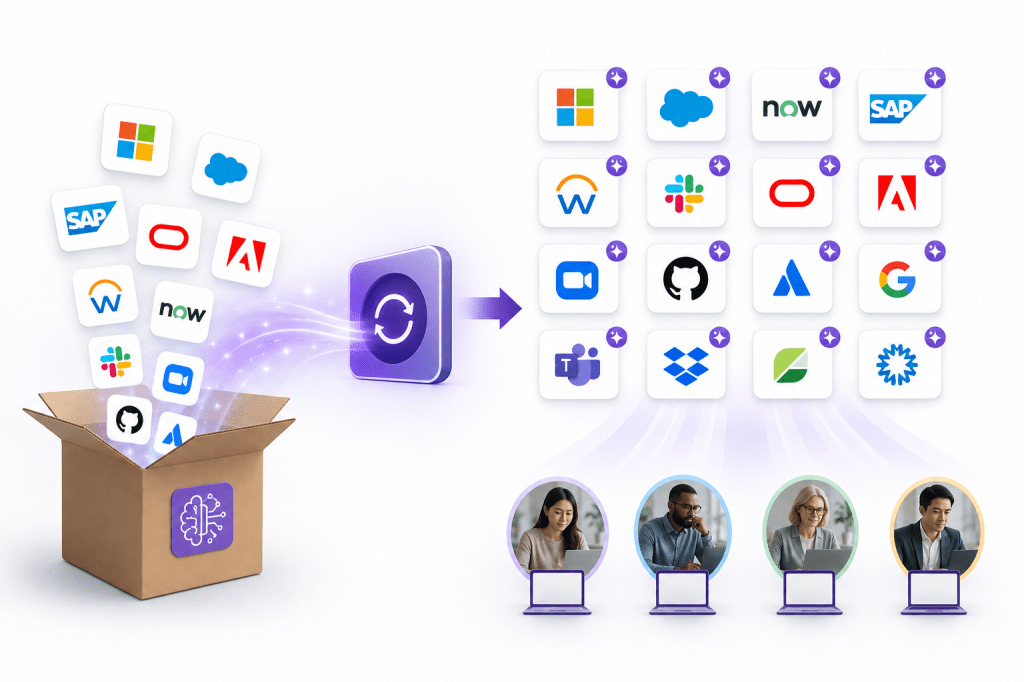
Most enterprise AI will not be code your teams wrote. It will arrive inside the platforms you already bought — a feature in a release note, a toggle enabled by default. A platform of gateways and prompt registries governs the minority of your portfolio. Whatever governs the rest has to be expressed as what you require, not what you run.
Two things survive both columns: your labeled dataset and your measurement contract. Neither is a platform component, and both are vendor-independent by construction.
The practical consequence is that your evaluation dataset belongs in procurement. “What accuracy does this achieve on our 200 cases, and can we retest at renewal” is the only real lever over an embedded AI feature — and no function in most enterprises currently asks it.
Seven Artifacts
Everything that survived the teardown lands here.
Accuracy report — the standard format, published before release
Threshold and rationale — signed by the business owner, because “why 92%” has a dollar answer
Measurement contract — what gets recorded when a person reviews output
Authority declaration — what the output is permitted to cause, and what it can never cause
Unit cost — against the manual baseline, captured before go-live
Data classification — what class of data, and where inference runs
Vendor terms — for anything embedded
Seven items. That is a form, reviewed in the forums you already run.
AI needs new questions in those forums, not a new forum.
Tier It, or It Gets Ignored
Requiring all seven for every use of AI would be quietly routed around. Tier by what happens when it is wrong.
Advisory — a person reads it and decides. Authority declaration and periodic spot checks.
Assistive — a person confirms every output. Add the accuracy report and measurement contract.
Autonomous — it acts without per-case review. All seven, plus scheduled re-evaluation.
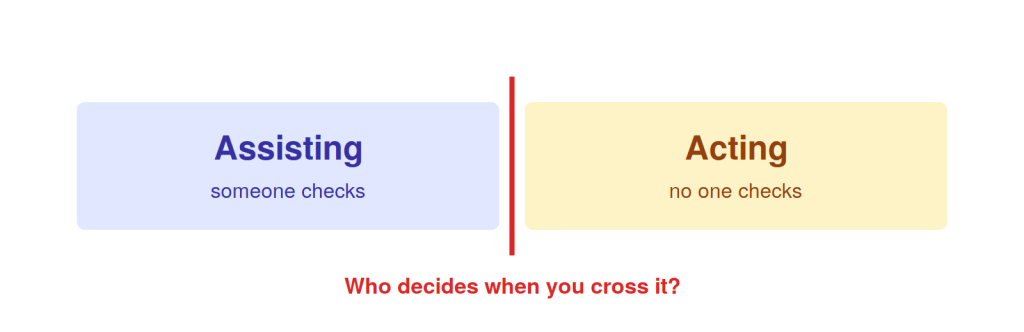
The boundary between assistive and autonomous is your auto-processing threshold. Which gives the single most useful rule in the framework.
Without it, an enterprise crosses from assisted to autonomous silently, while an engineer tunes a number to improve throughput. Nothing announces that the human control was removed.
And this is the one place governance needs data rather than a form. If every capability lands its review records in a common place, the share running without human confirmation is a query, not a survey. Without it, tiering is a policy you assert. With it, tiering is a policy you can see.
Moving the threshold is a governance event, not a configuration change.
The Inventory Problem Is Discovery, Not Storage
You need to know where AI is running. A purchased register is accurate on the day it is populated and stale within a quarter.
And it does not find the AI you most need to know about — the feature that shipped in a release, or the toggle enabled by default. No request was filed. No architecture review triggered.
What works is one question in three places you already have: vendor renewal, new software procurement, and release-note review for platforms already in place.
The inventory is a spreadsheet fed by those checkpoints. Keeping it current is the work. The container is irrelevant.
Who Owns It
Not a new team. The measurement table needs someone reading it monthly, and thresholds need reviewing quarterly with the owners who signed them.
The division that works is a central view and a local fix. Central sees what no single team can — the same failure across three capabilities, a threshold that moved without a decision, a correction rate near zero that means reviewers stopped checking. The team that wrote the code makes the change.
One hard rule, and only one. A change to the auto-processing threshold requires a published report and a signature. Everything else is advisory.
Describe the role as monitoring quality and delivery teams will hear an audit function, then manage the number instead of the system.
The Whole Series, Decoded
What it is called
What it is
Model gateway
IAM, a private network path, and cost tags
Prompt management
A folder in source control
Structured output layer
One parameter on the request
Guardrails
A config toggle, a validation function, and three written rules
AI evaluation platform
200 labeled cases and a scoring script
LLM observability
A log line, plus a join to what happened next
Golden dataset infrastructure
Records you already have, plus two days marking provenance
Human-in-the-loop service
A screen in the application
Vector database
A feature of the database you already run
Agent runtime
A function, once someone writes the sequence down
Model registry, feature store, GPU platform
Real only if you train models
AI governance platform
A form and a gate
Every row on the right is something an enterprise already knows how to do. That is the finding.
The difficulty was never technical. The vocabulary made familiar work look like new infrastructure, and new infrastructure looks like it needs a team.
Strip the vocabulary and what remains is a form, a gate, and someone accountable for saying no.
Final Thoughts
Sixteen components, taken apart against real work.
One piece of infrastructure, owned by a team you already have. One shared table. Two schemas. A handful of build checks. A form and a gate.
The rest was existing systems, existing teams, and existing forums — wearing names that made them look new.
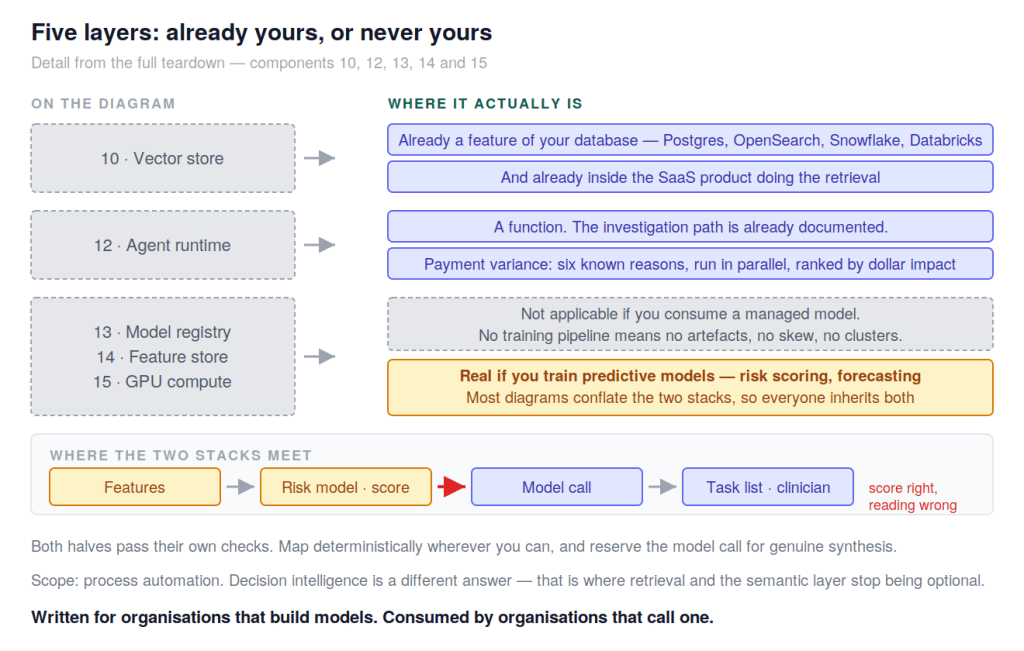
Vector databases, agent runtimes, model registries, feature stores, GPU clusters. Five foundational layers in the standard AI architecture diagram. If you consume a managed model, most are either features of software you already run or infrastructure for a problem you do not have.
A claim paid less than the contracted rate, and someone has to work out why.
The reasons are known. The contracted rate was applied incorrectly. The service was bundled. A modifier changed the allowed amount. Patient responsibility was miscalculated. A sequestration adjustment applied. A prior overpayment was recouped.
Six checks. Revenue cycle teams have had that list written down for twenty years.
So run them. In parallel, since none depends on another. Collect what fires, rank by dollar impact, present with the supporting data. A model call reads the remittance narrative where one exists. Everything else is lookups and arithmetic.
That is not an agent. It is a function.
Agents: The Question Is Not Which Framework
The comparison usually offered is a managed agent service against an orchestration library. It is the wrong comparison — both require the same integration code. The lookups against your contract system, eligibility, and payer rules get written either way.
The real question is whether you let the model decide the sequence. Saying yes costs more than it appears:
Every lookup must become independently callable with arguments the model generates, rather than called once with a validated parameter. That is a wider surface than you had.
You cannot unit test the orchestration, because it is decided at runtime.
A wrong sequence produces a plausible wrong answer with no error. Skip the check for an existing authorization and you tell staff to submit a duplicate. Nothing failed. The answer just looked fine.
Those costs are real, but they do not make the pattern wrong. They make it something to earn.
Two Tests, and Both Must Fail
An agent is unnecessary only when the work fails both of these. Most arguments about agents conflate them.
Scope. Does the work stay inside one domain, or coordinate across systems that each own part of the outcome? Payment variance sits in one domain, against one set of contract and remittance data. A procurement workflow spanning contracts, supplier validation, approval routing, ERP posting and email does not.
Sequence. Is the path documented, or does it genuinely vary per instance? In mature single-domain work it is documented, or documentable in an afternoon with someone who has done it for a decade. Claims adjudication, underwriting, accounts payable exceptions, credit review. Across systems and business units the combinations stop being enumerable even when each individual step is known.
All five use cases in this series fail both tests, which is why none of them needs an agent. That is a fact about this portfolio, not about enterprises — and the portfolio was deliberately chosen from work that sits inside a single domain.
Cross-system automation is where the pattern genuinely begins, which is the argument I made in Realizing Enterprise Agentic Architecture. A customer service agent reaching across CRM, knowledge, ticketing and workflow, or a procurement agent coordinating contracts, approvals and ERP transactions, is doing something a function cannot reasonably express.
Where the reflex still deserves resistance is the single-domain case. Reaching for an agent because nobody wrote down the process is expensive avoidance — an analysis gap, not an architecture requirement.
And the runtime is not the decision. Deployment patterns, identity and authorization, evaluation, observability, and lifecycle management are what a platform team actually provides. Those are the paved road. The framework is an implementation choice made underneath it.
Single domain with a documented path is a function. Cross-system coordination is where agentic architecture starts.
Retrieval: You Bought It Twice Already
Vector databases are presented as foundational infrastructure. Two things have happened since that diagram was drawn.
Vector search became a database feature. Postgres, OpenSearch, Elastic, Snowflake, Databricks, SQL Server, Mongo. If you run any of them, you already have it.
And purchased products ship their own. Any product doing document search, policy lookup, or knowledge assistance has retrieval inside it, indexed against its own content. You are not going to re-index your core platform’s knowledge base into your vector store, and you should not want to.
So the question is not which vector database. It is whether you need a retrieval step at all.
If the answer is a specific known record, look it up. Does this plan require prior authorization for this procedure code? That is a filtered query returning a specific rule with a citation. Semantic search returns documents that resemble the question — and nearly right is useless when the answer determines whether you get paid, and unauditable when someone asks how you reached it.
Where retrieval genuinely applies, quality is determined by chunking, metadata, freshness, and citations. None of which is the database. And measure retrieval separately from the answer: if the right document was never retrieved, no prompt change helps.
The MLOps Layers, and an Important Exception
Model registry. Feature store. GPU infrastructure. Training pipelines and drift monitoring.
If you consume a managed model, all of it is irrelevant. Your model registry is a version identifier in a configuration file. There is no training pipeline, therefore no consistency problem between training and serving. There are no clusters to schedule.
The exception is real and worth stating plainly. Enterprises run predictive models — clinical risk scoring, propensity models, forecasting. Those genuinely need versioned artifacts, feature consistency, training lineage, and drift monitoring. Mature discipline, existing owners, legitimate components.
The problem is that most enterprise AI diagrams conflate the two stacks. An organization running one risk model inherits the infrastructure requirements of a model builder, then applies them to its document extraction work as well.
And these systems increasingly sit in the same pipeline. A risk model produces a score, and a model call turns that score into something a clinician can act on. Two halves, two governance regimes, one seam.
The seam is where the risk concentrates, because it produces a failure neither half can detect: the score is correct and the interpretation is wrong. Both halves pass their own checks.
The practical rule is that anything mappable deterministically should be. A risk tier maps to protocol-mandated actions through a table, not a generation step. Reserve the model call for what genuinely requires synthesis, and most of the audit problem disappears with it.
One Boundary Worth Stating
This series is grounded in process automation — documents arriving, data read, a decision made, a system of record updated.
Decision intelligence is a different answer. Forecasting, margin analysis, churn, planning — work that reasons across enterprise data, metrics, policies, and history. That is where a lakehouse, retrieval, and a semantic layer stop being optional and become architectural capabilities.
The components dismissed on this page are not deletable there. They are deletable here.
Not every AI technology belongs in every enterprise architecture. The failure is applying one diagram to different classes of work.
Final Thoughts
A large share of published enterprise AI architecture is written for organizations that train and serve models, and consumed by organizations that call an API. Starting at layer one solves a problem you do not have.
Five layers. Four are not applicable to a managed-model consumer, and the fifth is a feature of a database you already run. The agent runtime is the one that turns on what you are automating rather than what you are buying.
The industry has produced a standard picture of what a company needs to do AI properly. Sixteen components, layered like a stack. It is on every consulting deck and every vendor slide.
We took it apart against real work — reading incoming referrals, processing invoices, investigating short payments, recommending next steps for a complex patient.
What we found: almost all of it is work your organization already does, under an unfamiliar name. One thing is genuinely missing, and it is not a technology.
What this is about, and what it is not
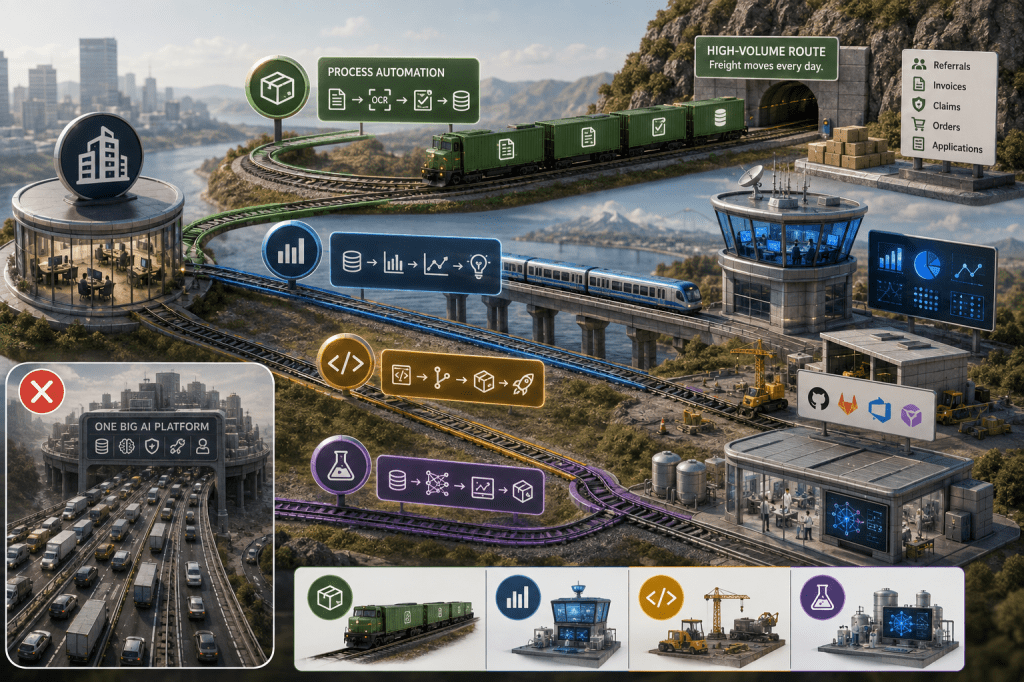
This is about process automation — the routine, high-volume work moving through your business every day. Documents arriving, data read, a decision made, a system updated. Referrals, invoices, claims, orders, applications. It is the largest AI opportunity in most companies, and the one where the standard architecture is most oversold.
Three other kinds of AI work are different, and this does not apply to them.
Analytics and decision support. Forecasting, planning, answering questions about your own numbers. Here the constraint is your data, not the AI — and fragmented, inconsistently defined data will not become intelligible because a model was pointed at it. That does require investment, and it is the one place an overhaul may be exactly right.
Engineering. AI is reshaping how software gets built. Different tools, different economics.
Research and model building. A department building models on your own data — clinical risk, pricing, demand — is doing specialist work with real infrastructure behind it.
The failure is applying one picture to all four, so a company running a single predictive model inherits the requirements of a company that builds models for a living, then applies them to invoice processing. Different workloads need different roads—not one architecture built for the hardest journey.
The picture was drawn for a different company
The companies publishing these architectures build and operate their own models. Their diagram reflects their problem: computing capacity, training pipelines, model versioning. Your company almost certainly buys AI as a service, the way you buy email or storage.
Applying their diagram to your business is like planning a distribution center because you bought a delivery van. Both involve logistics. Only one needs the warehouse.
The usual complaint about industry content is that it underestimates how complicated large enterprises are. Here it is the reverse. The real problem is simpler than the picture suggests, and organizations take on the complexity anyway — because that is what the picture showed.
Most of it, you already have
Securing access to a model is a configuration task for the team that secures everything else. Tracking the instructions given to a model is what your software teams do with every other piece of code. Checking that an invoice total adds up is validation you would want whether a machine or a person entered it. Some of it you have bought twice — the search technology sold as essential AI infrastructure is now a standard database feature.
This matters commercially. Each of these has an owner, a skillset and a budget line today. Presented as sixteen new components, it reads as a new function needing new people. Presented accurately, it is existing teams doing familiar work.
And most of it will arrive without you buying it
The majority of AI in your company will not be built by your teams. It will appear inside software you already licensed — a feature in a release, a setting switched on by default. No one requested it, no review was triggered. It is simply there, in the hands of staff who act on what it suggests.
You cannot govern that with internal tooling, because it is not yours. You govern it by changing what you require of any system, from anyone, before it is trusted with real work.
What is actually missing
Your organization knows how to test software: the same input should produce the same result every time.
These systems do not work that way. They are right most of the time and wrong some of the time, and the proportion shifts quietly — when incoming documents change, or a supplier updates their model without telling you. A system can pass every check your company performs today and still be wrong far more often than anyone realizes.
Nobody owns the question of whether it is good enough. Not testing, which checks consistency. Not the delivery team, which will not set a bar for itself. Not procurement, which does not know to ask. Not your risk function, built for a different kind of model.
That is the gap — not a missing tool, a missing accountability. Closing it needs a few hundred examples where you already know the right answer, and someone senior enough to say a number is not good enough yet.
The technology is cheap and the judgment is not. Companies buy a system for measuring AI quality, then discover they have nothing to measure it against.
The line that matters, and the question that finds it
Inside every one of these systems is a threshold — the point above which the machine’s work is accepted without a person checking it.
Raising it is how the savings are earned; reviewing everything costs what the manual process cost. It is also the moment the system stops assisting your staff and starts acting on its own.
That is a decision about risk. It should be made deliberately, by someone accountable, with evidence in front of them. Today it is usually a setting an engineer adjusts to improve throughput. Nothing announces that the human check was removed.
So ask whoever runs this for you: how much of our AI now runs without a person confirming it, and who signed off on that number?
A percentage with a name attached means the discipline is working. “I would have to check” means the line moved on its own.
What this means for what you fund
Fund the accountability, not the architecture.
Some cloud configuration. One place where quality across every AI system is visible. Expert time to build the examples that define what “correct” means in your business. And a rule that nothing reaches production, built or bought, without a published accuracy number and a named owner for the threshold.
What can wait: the specialist tooling and a team to build it. That earns its place once many systems are running and the shared burden is real. Standing it up first produces a capability nobody asked for — while the AI that actually matters arrives quietly inside software you already own.
The bottom line: The vocabulary made familiar work look like new infrastructure, and new infrastructure looks like it needs a new team. Strip the vocabulary and what is left is a standard, a gate, and someone accountable for saying no.
If You Want the Detail
This piece is the short version. The full teardown walks all sixteen components against real work.


 Tech Canvas