Most Enterprise AI Architecture discussions begin with agents, MCP, vector databases, and knowledge graphs. A more practical approach is to start with the business outcomes enterprises are trying to achieve and identify the small set of new capabilities required to augment existing enterprise architecture.
The Problem with Most AI Architecture Diagrams
Spend ten minutes browsing Enterprise AI Architecture diagrams and a pattern quickly emerges.
The diagrams are filled with agents, MCP servers, vector databases, knowledge graphs, orchestration frameworks, and autonomous workflows.
What is often missing is a simple question:
What business problem is the architecture trying to solve?
In my previous article, Let’s Rethink Reference Architecture Diagrams, I argued that reference architectures should be strategic guides rather than static technology diagrams.
The same principle applies to Enterprise AI Architecture.
Before discussing technology, we should first understand the transformations enterprises are trying to achieve.
For most organizations, AI investments fall into three categories:
- Build software faster and better -> Product lifecycle AI
- Automate enterprise processes -> Process automation AI
- Improve decision making -> Decision intelligence
Everything else is implementation detail.
Enterprise AI at a Glance
| Use Case | Business Goal | Existing Architecture | AI Augmentation |
|---|---|---|---|
| Product Lifecycle AI | Build software faster and better | Jira, Azure DevOps, GitHub, CI/CD, Testing, Security, Observability | Coding Assistants, AI Story Generation, AI Testing, AI Security Review, AI Operations Assistance |
| Process Automation AI | Automate enterprise work | BPM, Workflow Engines, RPA, SaaS Platforms, APIs, Integration Platforms | Document AI, LLM Reasoning, Workflow Copilots, Agent Runtime |
| Decision Intelligence | Improve business decisions | Data Warehouse, BI, Analytics, Reporting | Lakehouse, Catalog Discovery, Vector Retrieval, Decision Copilots |
A useful observation emerges from this table:
Most of the architecture already exists. AI primarily augments existing capabilities rather than replacing them.
Use Case 1: Product Lifecycle AI
The first opportunity is improving how software is designed, built, tested, secured, deployed, and operated.
This includes:
- Custom applications
- Cloud-native platforms
- SaaS configuration and extension
- Integration development
- Operational support
Most enterprises already have mature DevSecOps pipelines.
The architecture challenge is not replacing those pipelines.
The challenge is AI-enabling them.
Examples include:
- AI-assisted story creation
- Coding assistants
- AI-generated testing
- AI-assisted security reviews
- AI-assisted incident analysis
The key point:
This is AI-enabled DevSecOps, not a new software engineering architecture.
Use Case 2: Process Automation AI
The second opportunity is automating and augmenting enterprise processes.
This is often simplified as “agentic AI,” but several distinct patterns exist:
- SaaS-native AI capabilities
- AI-enabled custom applications
- Agentic and RPA-based automation
- Knowledge-worker assistants
A common automation pattern looks like:
Email ↓Document Extraction ↓LLM Reasoning ↓Workflow / RPA ↓ERP / CRM / Legacy Systems
The underlying enterprise systems remain unchanged.
AI automates the coordination layer.
The key point:
Most process automation continues to leverage existing enterprise systems and workflows.
Use Case 3: Decision Intelligence
The third opportunity is improving how decisions are made.
Examples include:
- Revenue forecasting
- Customer churn analysis
- Margin optimization
- Supply chain planning
- Investment prioritization
Unlike the first two use cases, decision intelligence requires AI to reason across:
- Enterprise data
- Business metrics
- Documents
- Policies
- Historical decisions
This is where technologies such as:
- Lakehouses
- Catalogs
- Vector retrieval
- Decision copilots
start becoming architectural capabilities rather than optional enhancements.
The key point:
This is where enterprise knowledge and reasoning become strategic assets.
Where the Buzzwords Actually Fit
Many technologies commonly discussed in AI architecture are only relevant to specific use cases.
| Technology | Product Lifecycle | Process Automation | Decision Intelligence |
|---|---|---|---|
| Coding Assistants | High | None | None |
| Document AI | Low | High | Medium |
| Agent Runtime | Low | High | Medium |
| Vector Retrieval | Low | Low | High |
| Lakehouse | Low | Low | High |
| MCP | Low | Medium | Medium/High |
| Knowledge Graph | Low | Low | Medium |
| RPA | None | High | None |
The takeaway:
Not every AI technology belongs in every enterprise architecture.
Architectures should be driven by use cases, not technology trends
Enterprise AI Architecture: Existing vs New
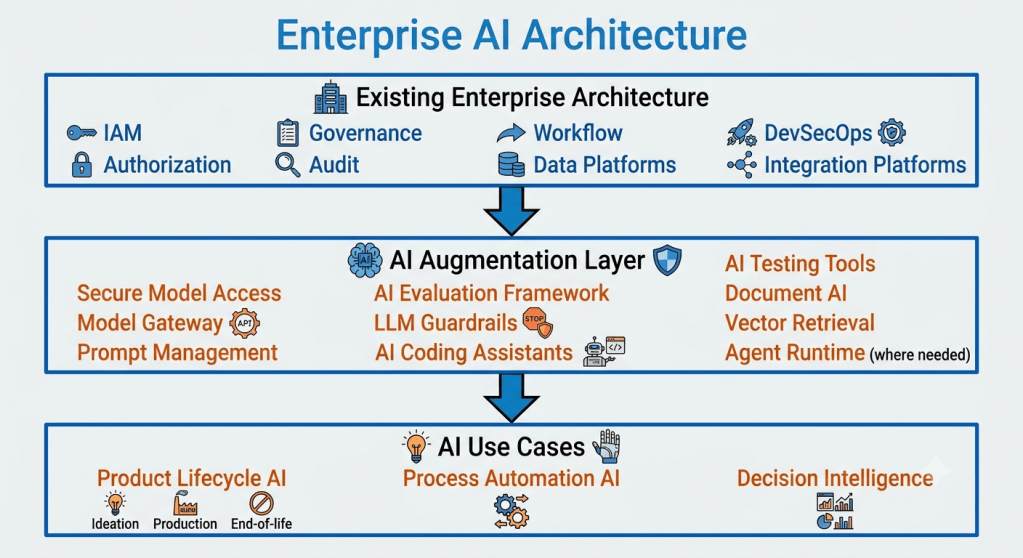
Enterprise AI is not a replacement for enterprise architecture. It is an augmentation of it.
Final Thoughts
Most Enterprise AI Architecture discussions begin with technology:
- Agents
- MCP
- Vector databases
- Knowledge graphs
The problem is that these technologies are often treated as architectural requirements rather than implementation choices.
A more practical approach is to start with the outcomes enterprises are trying to achieve:
- Build software faster and better
- Automate enterprise processes
- Improve decision making
Once those outcomes are understood, the architecture becomes much simpler.
Most of the enterprise architecture already exists:
- DevSecOps platforms
- Workflow and integration platforms
- SaaS products
- Data and analytics platforms
- Security and governance controls
AI introduces a relatively small set of new capabilities:
- Secure model access
- Model gateways
- Prompt management
- AI evaluation
- Guardrails
- Coding assistants
- Document AI
- Vector retrieval
- Agent runtimes where required
The role of Enterprise AI Architecture is not to introduce every emerging AI technology.
It is to identify where AI creates business value and selectively introduce the capabilities required to realize it.
Start with outcomes.
Let the technology follow.

