You are being asked to fund a foundation so that the work after it goes faster. The technology is real and the team asking is sincere. Three things to check before you approve it.

You are being asked to fund a promise
The value in the case is conditional. Nothing arrives this quarter, and the teams that would benefit are described in the future tense. That is not a technology judgment — it is a claim about what other people will do later. Gartner expects more than 40% of agentic AI projects to be cancelled by the end of 2027, mostly for escalating cost and unclear business value.
The spending is not reaching earnings
McKinsey’s 2026 survey of more than 1,700 leaders found 37% reporting any EBIT impact from AI, and 6% reporting meaningful impact. Both numbers were unchanged from the year before, while investment kept rising. Meanwhile 80% of users reported personal productivity gains. The money is moving. It is stopping at the desk.
The ones getting results did something else
Within that 6%, around three in four had redesigned the actual work rather than adding AI on top of it, and they were roughly twice as likely to have a defined way of measuring whether the output was any good. Neither of those is a platform.
Fund the use case. Generalize on the second.
Pay for one outcome that ships. When a second team needs the same thing, you will know what is worth sharing, because you will have built it twice and watched what repeated. Before that, the shared design is a guess — and guesses are what produce platforms nobody adopts.
Build once, reuse many was an economics argument
It held when building was expensive: you built once because building twice cost twice. Building is now far cheaper, and what you would standardize on is changing faster than you can build it. The conclusion does not survive its premise.
They will offer to share the cheap parts
Document reading, the pipelines, the plumbing that reaches the model. Those are days of work now, mostly configuration of something you already pay for. What is genuinely worth sharing is how you decide the output is good enough, and one place where that shows up for everything you run.
Most of it arrives anyway
Gartner expects a third of enterprise software applications to include agentic AI by 2028, up from less than 1% in 2024. Much of what is being requested will arrive through renewals, inside software you have already bought. Waiting a quarter costs less than it used to.
Ask for value every quarter
Release the money in quarterly tranches against delivered outcomes, and define what counts before the first one. “The gateway is deployed” is not value. “This process now runs at this volume, with this share going through without a person confirming it” is.
Final Thoughts
Nobody in the room is wrong. The ask is sincere, the technology works, and the team is usually right that something will eventually be worth sharing.
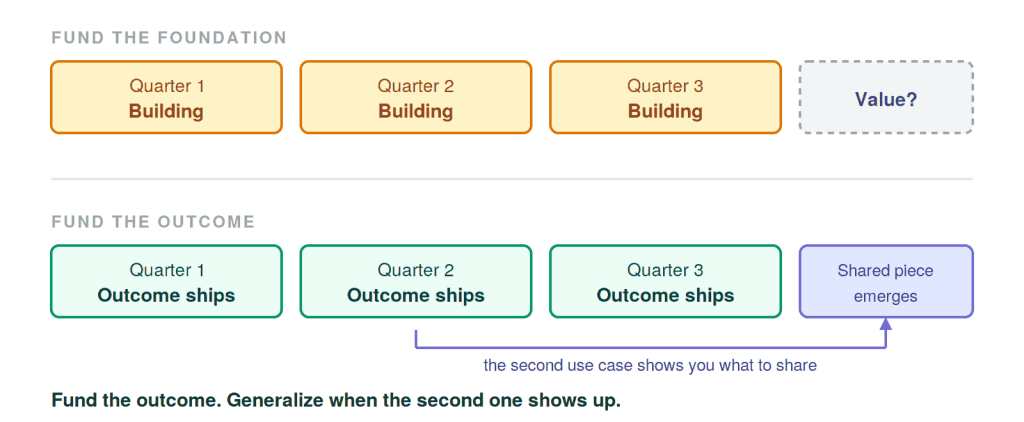
What is missing is evidence that value arrives before the money is gone.
Fund the outcome.
Generalize when the second one shows up.
 Tech Canvas