• In an era where transformation is no longer optional, many businesses turn to external consulting organizations to optimize operations, reduce costs, or unlock new revenue streams. These engagements often promise bold strategies, detailed roadmaps, and transformational outcomes. Yet, the results frequently underwhelm.

    The Problem: Strategy Without Execution Muscle

    While consulting partners may bring best practices and fresh perspectives, many engagements fall short due to two core limitations:

    1. Organizational Constraints: Consultants may be reluctant to recommend radical changes to operating models or organizational structures—especially when the internal appetite for disruption is low. This results in incremental rather than transformational recommendations.
    2. Technology Blind Spots: Despite technology being a core enabler of modern business models, consulting firms (especially business-centric ones) often lack deep insight into an organization’s current-state IT architecture, systems limitations, and integration debt. As a result, proposed changes are either unimplementable or too generic to drive differentiated value.

    These challenges aren’t hypothetical. Research by McKinsey suggests that 70% of large-scale transformation programs fail to meet their goals, often due to poor execution and lack of alignment between strategy and technical capability. Similarly, BCG has highlighted that technology underutilization is a key factor in stalled digital transformations.


    A Better Model: Embed Enterprise Architecture from the Start

    To change this trajectory, organizations must bring in their **technology leadership—specifically, a lean and business-savvy Enterprise Architecture (EA) team—**into the heart of transformation planning.

    While IT delivery leaders (e.g., IT Business Heads or Product Owners) play a vital liaison role, they are often focused on delivery pipelines and stakeholder management. They may not always have the mandate—or the holistic visibility—needed to architect long-term change. That’s where EA comes in.

    Enterprise Architects act as internal consultants who:

    Bridge business, technology, and finance, offering a full-spectrum view of what’s possible and what’s pragmatic.

    Provide critical input on current-state systems, integration points, and bottlenecks, allowing consulting partners to ground their recommendations in operational reality.

    Identify and prioritize technology enablers (e.g., platform modernization, automation, or AI adoption) aligned with strategic outcomes.


    Organizing Enterprise Architecture as an Internal Consulting Function

    To act as a true strategic partner, Enterprise Architecture (EA) must evolve into a lean, multidisciplinary team functioning like an internal consulting and strategy group—not just a technology governance function. Rather than assigning rigid roles, the EA team should be composed of individuals who collectively bring together a diverse blend of critical skills.

    1. Team Composition: Skills-Based, Cross-Functional

    The EA team should bring together the following core skill areas, which can be distributed across a small team of individuals—each member bringing depth in one or more of these domains:

    • Technology Leadership: Ability to assess platforms, systems, integration patterns, and technical bottlenecks at a strategic level.
    • Product Thinking: Translating business outcomes into capabilities and experiences, prioritizing initiatives with clear value to users and customers.
    • User Experience (UX): Ensuring that transformation outcomes improve usability, adoption, and customer satisfaction—often overlooked in enterprise initiatives.
    • Financial Acumen: Modeling TCO, ROI, and cost-per-transaction metrics to prioritize the most cost-effective and impactful changes.
    • Business Domain Expertise: Understanding of processes, KPIs, regulatory realities, and pain points within specific business functions.
    • Enterprise Architecture: Synthesizing business, tech, and financial inputs into coherent strategies and transformation roadmaps.

    The composition is flexible: a single individual may bring multiple of these skills, allowing the team to stay lean while still being effective.

    This skills-based design enables the EA function to operate as a focused transformation office—small enough to be agile, yet diverse enough to be effective.

    2. Engagement Model

    • Partnered early in strategic or consulting engagements to shape direction, not just validate proposals.
    • Serves as the connective tissue between external consultants, internal stakeholders, and delivery organizations.
    • Owns current-state diagnostics, business-technology alignment, and the translation of strategies into executable technology-enabled roadmaps.

    3. Mindset and Operating Principles

    • Enabler, not gatekeeper: The EA team’s goal is to unlock progress—not control it.
    • Business-first, tech-grounded: All recommendations tie directly to business outcomes and are underpinned by technical and financial feasibility.
    • Metrics-Driven: EA must champion measurable impact—whether in cost savings, time to market, or experience improvements.

    This structure positions EA to act not as a documentation team or solution review board, but as an internal strategy engine, accelerating the path from insight to impact.


    Conclusion: From Advisory to Action

    External consultants can be valuable partners in driving change—but without a strong internal technology ally, they often operate with blinders on. A well-structured Enterprise Architecture team provides the connective tissue between vision and execution, helping organizations avoid transformation theater and instead realize tangible outcomes.

    If your business is investing in high-stakes strategy work, make sure EA has a seat at the table. Not just as a downstream reviewer—but as an upstream partner, guiding decisions from ambition to action.


    Sources & Further Reading:


  • Every year, companies invest billions in top-tier consulting firms to transform operations, unlock revenue, and reshape strategy. These engagements promise sharp insights, proven frameworks, and game-changing impact.

    But behind the polished PowerPoint decks and strategic roadmaps lies a troubling pattern: a significant number of consulting engagements fail to deliver the results they promise.

    This article explores why that happens—and what organizations can do differently to protect their transformation investments.


    💥 The Reality Behind the Slide Decks

    While consulting firms are often staffed with smart, motivated professionals, their output doesn’t always translate into sustainable value. In fact:

    • Up to 70% of large-scale transformations fail to achieve their goals, according to McKinsey. Causes include lack of internal buy-in, poor execution capability, and strategies that don’t align with operational realities.
    • A widely cited report revealed that 84% of executives believe major consulting firms provided “no help at all” to their business transformation. Even more alarming—3% said the advice harmed their company. (Source: The Spectator, 2023)
    • BCG’s analysis of over 1,000 transformations found that only 30% fully meet their performance targets, with many failing to deliver lasting change.

    These are not isolated outliers—they reflect a broader failure pattern.


    🧠 Real-World Examples of Misfired Consulting

    • Motorola & McKinsey: In 2006, McKinsey was brought in to help Motorola regain market leadership. Despite expensive strategy work, the company failed to pivot fast enough, leading to missed market shifts, layoffs, and eventual acquisition. The consulting advice lacked urgency and underestimated execution complexity.
    • Reddit Whistleblower Posts from current and former consultants share insider stories of:
      • Prototype-level tools paraded as complete solutions
      • Engagements steered toward generating follow-on work, rather than solving client problems
      • Strategy recommendations that knowingly conflict with client context or capability

    🔎 Why These Engagements Fail

    Root CauseDescription
    No execution accountabilityExternal consultants often exit post-recommendation, leaving the hardest part—execution—to disconnected internal teams.
    Surface-level insightWithout deep context or systems understanding, recommendations can be generic or impractical.
    Misaligned incentivesFirms may steer clients toward large-scale programs, new platforms, or “frameworks” that drive billing—regardless of actual need.
    Cultural mismatchConsultants underestimate resistance to change, internal politics, and structural blockers.
    Tech is sidelinedBusiness consultants often lack the technical depth to propose feasible solutions—leading to technology being underutilized or mismatched.

    ✅ A Smarter Path: Pairing Consulting with Internal Capability

    None of this means consulting is useless. But it must be matched with strong internal capability—especially at the intersection of strategy, technology, and execution.

    One effective approach? A lean, cross-functional Enterprise Architecture (EA) team that works in tandem with consultants from day one.


    🧩 EA as an Internal Consulting Partner

    A modern EA team—staffed with people who bring together technology leadership, product strategy, financial modeling, UX, and domain expertise—can:

    • Validate the feasibility of proposed changes across systems, platforms, and processes
    • Translate strategy into executable, costed roadmaps
    • Provide current-state transparency that consultants often miss
    • Ensure recommendations tie back to business value—and are deliverable

    This internal team acts as a “connective tissue” between external vision and internal reality—increasing the odds that consulting doesn’t stop at insight, but delivers impact.


    🔚 Final Thoughts: Reimagining Transformation

    If your organization is planning or mid-way through a major consulting engagement, ask yourself:

    • Do we have internal counterparts who can challenge, validate, and translate what’s being recommended?
    • Are we investing in our own ability to execute—or just outsourcing the thinking?
    • Is technology viewed as a strategic enabler—or a footnote in the final report?

    The most successful transformations aren’t just advised. They are co-created—with empowered internal teams who can carry the torch long after the consultants leave.


    📚 References

    1. McKinsey & Company – “Why Do Most Transformations Fail?”
    2. BCG – “Flipping the Odds of Digital Transformation Success”
    3. The Spectator – “The Great Consulting Farce”
    4. Reddit Threads on Consulting Industry – Link 1

  • For decades, businesses have pursued transformation through changes in process, structure, and strategy—often guided by external consultants and internal change agents. But in today’s world, where every customer experience, operational process, and growth opportunity is digitally infused, technology is no longer just an enabler—it’s a core driver of competitive advantage.

    And yet, in many transformation efforts, technology remains sidelined or under-appreciated, introduced only after the strategy is defined. This approach is no longer viable.


    🔍 Transformation Without Tech Is an Incomplete Playbook

    Business leaders often engage consulting firms to boost efficiency, cut costs, or unlock growth. These engagements yield high-level strategies, process maps, and org design changes. But without meaningful integration of technology insight and execution capability, these strategies are often:

    • Unimplementable due to system constraints
    • Incremental instead of transformative
    • Quickly obsolete in a rapidly digitizing market

    As research from McKinsey shows, about 70% of large-scale transformations fail, often because of poor alignment between business strategy and technology capabilities—highlighting the need to integrate technology planning early in the process (McKinsey & Company). Similarly, BCG’s study of over 1,000 digital transformations found that only 30% meet or exceed their goals, with technology capability and agility being critical success factors (BCG).


    💡 Why Technology Is the Differentiator Today

    In nearly every industry, the companies that lead in growth, efficiency, and customer satisfaction share a common thread: strategic use of technology. Technology is not a support function—it’s a differentiator.

    Here’s why:

    1. New Business Models Are Technology-Enabled
      Subscription services, on-demand platforms, AI-driven personalization, and ecosystems only work because of scalable technology foundations. Gartner emphasizes that Enterprise Architecture must evolve to align business and technology strategy to enable such models (Gartner Research).
    2. Customer Experience Is Digital by Default
      Real-time interactions, mobile apps, and personalized services rely heavily on technology as the customer’s interface to your business.
    3. Efficiency Requires Automation and Intelligence
      Operations today depend on automation, data analytics, and machine learning—none of which are possible without modern tech infrastructure.
    4. Speed to Market Demands Digital Agility
      Winning companies deploy new features in days, not quarters, thanks to cloud-native architectures and agile delivery models.

    🚨 The Risk of Technology as an Afterthought

    When business strategy is developed without technology leadership, organizations risk creating plans disconnected from system realities. Forbes highlights that digital transformation fails when technology is treated as a supporting function instead of a core enabler (Forbes).

    This disconnect leads to:

    • Costly rework
    • Transformation fatigue
    • Misaligned investments
    • Vendor decisions that don’t scale

    🧠 The Fix: Put Technology at the Strategy Table

    Successful transformations require technology leaders and teams who understand both business and technology—like a modern Enterprise Architecture (EA) function. Harvard Business Review stresses that digital transformation succeeds when technology, talent, and processes align (Harvard Business Review).


    🧩 Enterprise Architecture: The Strategic Tech Translator

    A well-constructed EA team acts as an internal consulting partner that:

    • Validates that strategies are technically feasible and financially sound
    • Recommends modern platforms and architecture to enable new business models
    • Identifies system bottlenecks blocking progress
    • Translates goals into executable, measurable roadmaps

    They ensure technology shapes strategy—not just supports it.


    🔚 Conclusion: In Transformation, Technology Is the Strategy

    Every transformation today is inherently a technology transformation. Ignoring this is a main reason so many efforts stall.

    If you’re defining bold new goals, ask: Is technology at the center of your strategy—or just along for the ride?

    Put technology front and center—and increase your chances of transformation success.

  • The Quiet Revolution Driving Business Resilience

    When we think about digital transformation, it’s easy to picture tech giants, cloud-native startups, or global consultancies disrupting industries with cutting-edge platforms. But beyond the headlines, a quieter — yet no less significant — technology revolution is underway in sectors not traditionally seen as technology-first.

    We’re talking about healthcare systems, insurance carriers, retail chains, manufacturers, and other brick-and-mortar enterprises. These are not product-based SaaS providers or digital-native firms — their core business models are rooted in service delivery, operations, logistics, and regulatory compliance, often with decades of legacy systems under their roofs.

    Yet the pressure to modernize has never been greater.


    📊 The Reality of Tech Modernization in Traditional Enterprises

    Recent studies paint a clear picture:

    • 71% of Fortune 1000 companies in non-tech industries report that legacy systems are a barrier to agility and innovation (NewVantage Partners, 2024).
    • A 2023 McKinsey survey of large traditional enterprises found that over 60% are actively investing in cloud migration and data platform modernization.
    • Only 27% of insurers and 32% of healthcare systems report having a “modernized, cloud-native technology stack” — but nearly 85% say it is a top priority over the next 3 years (Gartner, 2024).
    • IDC forecasts that $350 billion will be spent globally on digital transformation initiatives in traditional enterprises in 2025 — more than half of that on core technology infrastructure updates.

    🚀 Eight Core Themes of Technology Modernization

    While each industry and company is unique, most traditional enterprises are converging on these common technology modernization themes:

    1. Data Platform Modernization

    Shifting from fragmented, siloed data systems to centralized cloud-based data lakes or federated data mesh architectures that support analytics, real-time insights, and AI readiness.

    2. Cloud Migration & Hybrid Infrastructure

    Moving core workloads and customer-facing applications to public and hybrid cloud environments to gain scalability, cost flexibility, and improved disaster recovery — while keeping sensitive data secure.

    3. Application Modernization with Cloud-Native Architectures

    Refactoring or replacing legacy monolithic applications with microservices, containerization, and modular frontends, enabling faster delivery, scalability, and easier maintenance.

    4. AI Enablement Across Business Functions

    Embedding AI into business processes such as fraud detection, supply chain optimization, personalized customer support, and predictive healthcare, leveraging modern data infrastructure and governance.

    5. SaaS Ecosystem Consolidation and Rationalization

    Reducing SaaS sprawl by standardizing platforms, renegotiating enterprise contracts, and eliminating duplicate tools to better control costs, data access, and security.

    6. IoT and Edge Modernization

    Integrating connected devices and edge computing into operations for real-time data collection and automation — from smart medical devices to retail inventory management and manufacturing telemetry.

    7. Enterprise Observability and Resilience Engineering

    Investing in real-time monitoring, distributed tracing, and service-level objectives (SLOs) to proactively manage system health, user experience, and operational risk.

    8. Agile Ways of Working and Operating Model Shift

    Adopting agile delivery models, cross-functional product teams, and DevOps mindsets to accelerate innovation, improve collaboration, and reduce organizational friction.


    🧩 Supporting Enabler Themes

    Alongside these core areas, enterprises are focusing on key enablers to ensure successful modernization:

    • API Strategy and Integration Platforms that enable flexible, reusable connections between systems.
    • Platform Engineering & Developer Enablement through self-service infrastructure and automation.
    • Security & Identity Architecture, including zero trust frameworks and robust identity management.
    • DevSecOps and Continuous Integration/Continuous Delivery (CI/CD) pipelines to speed safe releases.
    • Change Management & Workforce Upskilling to help people adapt and thrive in the new technology landscape.

    📌 Why This Matters for Millions of Businesses

    According to Forbes’ Global 2000 list, there are over 5,500 companies worldwide with a market capitalization exceeding $1 billion. These companies span various industries, including healthcare, insurance, retail, and manufacturing, and are increasingly investing in technology modernization to stay competitive.

    In the United States, the Fortune 1000 list ranks the 1,000 largest corporations by revenue, encompassing a significant portion of the nation’s economic activity. These enterprises are actively pursuing modernization efforts to enhance efficiency, agility, and customer experience.en.wikipedia.org

    Even if they don’t sell software, their ability to survive increasingly depends on how well they leverage technology.


    💡 Final Thought

    Technology modernization is no longer just the domain of Silicon Valley. For traditional businesses, it has become a matter of resilience, competitiveness, and future readiness.

    These efforts may not always be splashy, but they are reshaping the foundations of industries we all rely on — from the clinics that care for us to the stores we shop in and the insurers that protect our livelihoods.

    Modernization is here. The only question is how quickly traditional businesses can make the shift — and who will be left behind.

  • Technology modernization across large, traditional enterprises is often viewed as a collection of technical initiatives — cloud migration, AI enablement, data replatforming, and so on. But in reality, these transformations require strategic, cross-cutting decisions that affect the organization’s operating model, risk posture, talent landscape, and cost structure.

    This is where Enterprise Architecture (EA) provides essential guidance and structure.

    EA is uniquely positioned to bridge strategy and execution because of its responsibility to map the current state of systems, capabilities, data flows, and technical debt. By understanding what exists today — across cloud, data, applications, infrastructure, and vendors — EA teams can help organizations make informed, risk-aware, and cost-effective modernization decisions.

    In each of the eight core themes below, EA’s involvement ensures modernization efforts are:

    • Aligned to business value streams
    • Scaled to future growth
    • Resilient and secure by design
    • Built with long-term interoperability and agility

    Below is a deep dive into how EA helps drive these outcomes across key modernization areas, including the technology decisions, strategic implications, and EA’s critical role in shaping them.

    🚀 Modernization Themes and Enterprise Architecture’s Strategic Influence

    1. Data Platform Modernization

    🔧 Key Decisions:

    • Lakehouse vs. cloud data warehouse
    • Real-time streaming vs. batch
    • AI/ML readiness
    • Cost and scalability trade-offs
    • Data zoning and governance

    📉 Implications:

    • Choosing the wrong data platform can lead to excessive costs, inflexibility, or underutilized infrastructure.
    • A poor zoning strategy (raw, curated, consumer) impacts data discoverability, quality, and reusability.
    • Inadequate support for AI or analytics limits the business’ ability to generate insights or adopt automation.

    🧭 EA’s Role:

    EA performs detailed current-state data landscape analysis, defines reference architectures, and aligns platforms to support both analytics and AI goals. EA ensures consistency in data modeling, stewardship, and integration across domains.

    2. Cloud Migration & Hybrid Infrastructure

    🔧 Key Decisions:
    • Cloud provider strategy: Single vs. multi-cloud
    • Standardization of existing cloud workloads and environments
    • Vendor lock-in vs. portability (e.g., AWS Lambda, AppSync)
    • Network architecture, latency zones, and connectivity patterns
    • Data sovereignty, compliance, and regulatory boundaries

    📉 Implications:
    • Enterprises with non-standardized cloud usage often face inconsistent security, governance, and performance profiles across teams.
    • Single-cloud strategies simplify operations but risk dependency and regional limitations.
    • Multi-cloud adoption introduces flexibility but increases operational complexity and cost if not standardized.
    • Heavy reliance on vendor-native services can accelerate development but reduce workload portability.

    🧭 EA’s Role:
    Enterprise Architects assess existing cloud usage, define target-state landing zones, enforce standard network and identity patterns, and establish cloud governance frameworks. They help rationalize and standardize fragmented workloads, prioritize replatforming or refactoring efforts, and guide hybrid architecture decisions aligned with business goals and compliance needs.

    3. Application Modernization with Cloud-Native Architectures

    🔧 Key Decisions:

    • Microservices vs. monolith refactoring
    • Language/framework standardization vs. polyglot
    • Frontend patterns (e.g., micro frontends)
    • Integration architecture: API, event-driven, iPaaS

    📉 Implications:

    • Polyglot development increases flexibility but raises maintenance complexity.
    • Poorly planned microservices can lead to distributed monoliths.
    • Inconsistent integration patterns reduce interoperability and scalability.

    🧭 EA’s Role:

    EA defines modular reference architectures, balances developer autonomy vs. operational simplicity, and ensures secure, observable, and maintainable services.


    4. AI Enablement Across Business Functions

    🔧 Key Decisions:

    • Build vs. buy for ML platforms and models
    • Real-time vs. batch inference
    • AI governance and compliance models

    📉 Implications:

    Misalignment between AI and business use cases leads to low ROI.

    Inadequate AI governance risks compliance violations and reputational damage.

    Poor infrastructure planning limits scalability and performance.

    🧭 EA’s Role:

    EA maps AI capabilities to business outcomes, defines MLOps pipelines, and supports data pipelines with proper zoning, lineage, and explainability frameworks.


    5. SaaS Ecosystem Consolidation and Rationalization

    🔧 Key Decisions:

    • Vendor and platform selection
    • Identity integration and SSO
    • Data portability and ownership
    • iPaaS vs. direct API integration

    📉 Implications:

    • Redundant SaaS tools increase cost and security risk.
    • Poor integration reduces employee productivity and data coherence.
    • Weak identity management exposes the org to security threats.

    🧭 EA’s Role:

    EA inventories SaaS tools, maps them to business capabilities, and leads rationalization efforts. It defines integration standards, governance models, and security patterns to reduce sprawl.


    6. IoT and Edge Modernization

    🔧 Key Decisions:

    • Edge vs. centralized processing
    • Device management and security protocols
    • Integration into cloud and data platforms
    • Real-time vs. near-real-time architecture

    📉 Implications:

    • Poor edge design increases latency and weakens autonomy.
    • Insecure device protocols expand attack surface.
    • Disconnected IoT systems reduce data value.

    🧭 EA’s Role:

    EA defines IoT reference architecture, enforces security baselines, and ensures edge data pipelines integrate into enterprise analytics.


    7. Enterprise Observability and Resilience Engineering

    🔧 Key Decisions:

    • Observability platform selection (e.g., OpenTelemetry, Datadog, Splunk)
    • Standard metrics, logging, and tracing
    • Integration with SRE practices and incident management
    • Business-aligned SLOs

    📉 Implications:

    • Inconsistent observability reduces mean time to resolution (MTTR).
    • Lack of end-to-end tracing obscures root causes.
    • Poor SLO design misaligns tech teams from business expectations.

    🧭 EA’s Role:

    EA sets observability standards, embeds telemetry in reference architectures, and aligns reliability metrics with business outcomes.


    8. Agile Ways of Working and Operating Model Shift

    🔧 Key Decisions:

    • Adoption of scaled agile framework (e.g., SAFe)
    • Team structure: portfolio, product, and platform teams
    • Team collaboration patterns (inspired by Team Topologies by Matthew Skelton and Manuel Pais)
    • DevSecOps maturity and CI/CD automation
    • Funding model: CapEx vs. OpEx for persistent teams

    📉 Implications:

    • Without structured team design, Agile at scale becomes chaotic.
    • Over-centralized architecture slows product delivery.
    • Platform teams without clear boundaries create bottlenecks.
    • Misaligned funding limits the agility of persistent product teams.

    🧭 EA’s Role:

    EA provides capability maps, defines value stream-aligned team structures, and supports SAFe portfolio planning. It helps establish platform team boundaries, guides DevSecOps maturity, and ensures architectural coherence across decentralized delivery teams. EA evolves itself into a federated advisory role, enabling agility with governance, not gatekeeping.

  • From Ivory Tower to Value-Driven Enterprise Architecture

    Enterprise Architecture (EA) has long faced the challenge of being perceived as an “ivory tower” — a distant, slow-moving function that produces bulky documentation with limited direct business impact. This traditional model often struggles to keep pace with rapid technological change and evolving business demands, leaving stakeholders frustrated and transformation initiatives at risk.

    To truly deliver measurable business value, EA must evolve into a lean, embedded internal consulting organization that is deeply integrated with business, product, and user experience teams. Rather than operating in isolation, this modern EA approach emphasizes agility, collaboration, and strategic guidance that informs decisions across finance, security, labor models, and delivery prioritization.

    By restructuring EA into three focused groups — a Lean EA consulting team, Portfolio Architects, and Platform Product Owners — organizations can balance innovation with governance, enable reusable technology foundations, and foster alignment across complex portfolios. This shift transforms EA from a compliance-focused overhead into a proactive partner that accelerates transformation, optimizes investments, and ensures sustainable agility.


    Enterprise Architecture Groups Overview

    1. Lean EA Group (Internal Consulting Organization)

    Role:

    • Acts as an embedded internal consulting team driving strategic technology-business alignment.
    • Provides cross-disciplinary insights spanning product, UX, business domains, and technology.

    Key Skills:

    • Technical architecture & modernization
    • Product management & business strategy
    • User experience design
    • Business domain expertise (SMEs)
    • Facilitation & communication
    • Strategic analysis & risk management

    Key Deliverables:

    • Current state assessments (business & technology landscapes) to identify pain points, risks, and opportunities
    • Future vision & target operating model
    • Strategic roadmap with prioritized initiatives
    • Business cases with ROI and impact analysis
    • Stakeholder alignment presentations & decision frameworks
    • Governance recommendations for sustained alignment

    2. Portfolio Architects

    Role:

    • Ensure architectural consistency and strategic alignment within portfolios or business units.
    • Collaborate with Lean EA and Platform Product Owners to balance innovation with standardization.

    Key Skills:

    • Enterprise & solution architecture frameworks
    • Governance, compliance & risk management
    • Business strategy & financial acumen
    • Stakeholder management & negotiation
    • Analytical skills for trade-offs and impact

    Key Deliverables:

    • Current state assessments focused on portfolio architectural health and compliance
    • Portfolio-specific architecture standards & guidelines
    • Alignment reports and compliance tracking
    • Technology evaluation & trade-off analyses
    • Roadmaps linking portfolio initiatives with enterprise goals
    • Risk and opportunity assessments for investments

    3. Platform Product Owners

    Role:

    • Own platform capabilities and enable product teams through reusable technology foundations.
    • Balance cost, performance, and usability to accelerate delivery.

    Key Skills:

    • Product management & agile delivery
    • Technical expertise in cloud, APIs, automation
    • Operational excellence & metrics tracking
    • Vendor management & cost control
    • Collaboration with cross-functional teams

    Key Deliverables:

    • Current state assessments of platform capabilities, usage, cost, and performance
    • Platform roadmaps and release plans
    • Cost and performance metrics dashboards
    • Developer enablement and integration guides
    • Vendor evaluation and onboarding reports
    • Incident & risk management documentation

  • Evolving the Traditional EA Library into an AI-Enabled Knowledge Ecosystem

    Enterprise Architecture (EA) has traditionally relied on static libraries—repositories of standards, policies, and reference architectures—that often become outdated, siloed, or disconnected from real-world delivery teams. These conventional libraries, managed top-down, struggle to keep pace with fast-evolving technologies and dynamic business demands.

    To unlock true business value, the EA library must transform into a living, AI-enabled knowledge ecosystem that dynamically generates and refines standards, patterns, and guidance accessible to all teams.


    How Each EA Group Contributes to and Benefits from the AI-Enabled Library

    1. Lean EA Group: Research-Driven, Decision-Informed Content

    The Lean EA group’s consulting deliverables—such as current state assessments, strategic roadmaps, and business cases—feed into the AI-enabled library as foundational research content.

    • These deliverables serve as context-rich decision histories that AI can analyze to identify similar architectural or business scenarios.
    • When new transformation initiatives arise, teams can query the library to find past decisions, lessons learned, and recommended next steps aligned with proven outcomes.
    • This enables data-driven, continuous refinement of enterprise guidance, turning lessons into prescriptive, actionable insights.

    2. Portfolio Architects: Documenting Patterns and Architecture Decision Records (ADRs)

    Portfolio architects enrich the library with Architecture Decision Records (ADRs) and reusable architectural patterns they implement within their domains.

    • ADRs capture rationale, trade-offs, and outcomes of critical architectural decisions, forming a valuable reference for future projects.
    • Patterns documented include solutions to recurring problems, integration approaches, and compliance frameworks tailored to specific business units or technology stacks.
    • By contributing these artifacts, portfolio architects help create a living repository of validated architectural knowledge accessible enterprise-wide.

    3. Platform Product Owners: Publishing Usage Guidelines and Integration Patterns

    Platform teams contribute practical, hands-on guidance to the library by publishing:

    • Platform usage guidelines detailing available services, tooling, SLAs, and best practices.
    • Integration patterns showing how different platform components interoperate effectively, including API usage, event-driven models, or batch processing.
    • For example, a platform team may publish a prescriptive guidance document for hybrid integration platforms—specifying which tools (e.g., an enterprise service bus, API gateways, or message brokers) are available, the scenarios each tool fits best, and how to combine them optimally.

    Example: Collaborative Prescriptive Guidance for SaaS Integration

    Imagine a portfolio architect responsible for a SaaS platform like Salesforce or Workday:

    When a new use case arises—say, integrating a new HR system with Workday—the team can quickly identify the most suitable existing pattern to reuse or adapt.

    The portfolio architect documents integration patterns specific to that SaaS platform—such as event-driven synchronization or batch data loads.

    They link these patterns in the library to the platform team’s published integration tools and guidelines.

    This synergy accelerates delivery, reduces rework, and ensures compliance with enterprise standards—all enabled by the shared, AI-enhanced knowledge base.


    Shifting from Top-Down Enforcement to Collaborative Knowledge Sharing

    Unlike traditional EA approaches that rely on hierarchical enforcement of standards, this evolved model:

    • Encourages cross-team collaboration and contribution to the knowledge ecosystem.
    • Makes contributing to the EA library a key Objective & Key Result (OKR) for Lean EA consultants, portfolio architects, and platform product owners.
    • Provides a queryable index powered by AI that teams can interact with conversationally, surfacing prescriptive guidance tailored to their context.
    • Facilitates continuous learning and adaptation as new patterns emerge, platforms evolve, and business priorities shift.

    Conclusion

    Transforming the EA library into an AI-enabled knowledge ecosystem empowers enterprises to:

    Harness collective expertise dynamically and at scale

    Enable faster, better-informed architectural decisions

    Foster innovation while maintaining alignment and governance

    Promote a culture of shared responsibility and continuous improvement

    This new paradigm ensures EA is no longer an ivory tower, but a vital, living asset that accelerates enterprise transformation and delivers measurable business value.

  • Governance is often misunderstood as a relic of slow-moving enterprises. But in reality, it is a critical enabler of sustainable, aligned decision-making — especially in businesses undergoing complex transformation across multiple fronts.

    These are not software-first or tech-native companies. They are organizations in healthcare, insurance, retail, logistics, and manufacturing — whose business models are not built around selling software, but are now being reshaped through technology.

    In these enterprises, modernization is not a one-time overhaul. It is a multi-year, multi-program transformation — often involving legacy systems, compliance regulations, global teams, and fragmented architectures. Governance is essential not to slow teams down, but to ensure:

    • Strategic alignment across siloed initiatives
    • Informed decisions that factor in downstream implications
    • Visibility for leadership across infrastructure, business, and finance

    🏗️ Modernization Themes and the Role of Governance

    Many traditional enterprises are in varying stages of transformation across a consistent set of modernization themes. For those that have fully embraced maturity across the following themes, governance must evolve into a lighter-weight, federated, and decentralized model:

    • Data Platform Modernization: Cloud-based lakehouses and real-time data platforms with self-service and AI capabilities
    • Cloud Migration & Hybrid Infrastructure: Predominantly serverless workloads and rationalized use of multi-cloud environments
    • Application Modernization: Cloud-native development using microservices and micro frontends, with standardized integration patterns
    • AI Enablement: Embedded AI/ML into business processes with governed MLOps and explainability
    • SaaS Consolidation: Rationalized SaaS portfolios with centralized identity and integration
    • IoT and Edge Modernization: Well-integrated edge intelligence with cloud analytics
    • Enterprise Observability: Mature telemetry, tracing, and reliability metrics aligned with business SLAs
    • Agile Operating Model: Teams structured via product-platform models, influenced by SAFe and Team Topologies

    In such organizations, governance becomes more about reinforcing alignment and facilitating visibility rather than mandating direction. Architecture advice groups and lean governance mechanisms become more effective than traditional gatekeeping.

    However, for the majority of enterprises still undergoing transformation across these areas, the need for structured governance is significant.

    🧩 Why Governance is Essential During Transformation

    Even as organizations adopt modern practices — cloud-native, serverless, SaaS consolidation, data lakehouses — they may still:

    • Maintain legacy systems or host mission-critical platforms on-prem
    • Operate in regulated environments with compliance constraints
    • Execute transformation programs at different paces across business units

    Without effective governance:

    • A platform team may invest millions in a container platform, while product teams transition to serverless
    • A central IT group might renew on-prem database licenses while the data team moves to a cloud lakehouse
    • Integration patterns proliferate unchecked, creating long-term technical debt

    These aren’t just technical mismatches — they lead to missed business goals, redundant spend, and avoidable delays.

    🔎 What Decisions Require Governance?

    Governance is not about policing every Jira ticket. It’s about reviewing and aligning decisions with strategic, cross-functional impact, such as:

    • Adoption of new technologies or frameworks (e.g., service mesh, low-code tools, AI platforms)
    • Build vs. buy evaluations for shared platforms or developer tooling
    • Integration or data sharing architecture between domains or BUs
    • CapEx investments in hardware, licenses, infrastructure refreshes
    • Strategic SaaS and cloud implementations that cut across business lines
    • Long-term vendor partnerships or contractual commitments

    These decisions shape an organization’s technical, financial, and operational future — they must be governed intentionally.

    🛠 Mechanisms for Governance: From Control to Enablement

    Governance in modern enterprises must evolve into a layered, collaborative process that supports decision-making without paralyzing progress. In the context of traditional organizations transforming through modernization themes, the following governance mechanisms work best:

    1. Team-Led Architectural Ownership

    • Teams initiating significant changes take responsibility for engaging relevant stakeholders early.
    • They socialize ideas with impacted groups (e.g., security, operations, EA) and gather input before advancing the proposal.

    2. Architecture Advice Process (from Keeling’s Framework in Facilitating Software Architecture)

    • Peer-driven, voluntary sessions focused on architectural alignment and shared learning
    • Encourages early discovery of technical or operational misalignments
    • Organized around domain-specific topics (e.g., cloud, security, data)

    3. Lean Enterprise Architecture Group

    • Provides templates, roadmaps, and reusable assets
    • Functions as a facilitative center — enabling consistent practices, not enforcing them
    • Forms a networked federation of architects embedded across programs

    4. Architecture Review Board (ARB)

    • A single, cross-functional governance body to review decisions with enterprise-wide implications
    • Brings together architecture, finance, procurement, security, and delivery leaders into a shared decision forum
    • Acts as the convergence point — not for control, but for visibility, risk management, and execution alignment
    • Not a control board, but a visibility and alignment mechanism
    • Reviews decisions with high strategic importance or financial implication
    • Offers a forum for leadership — not only technical, but also finance, product, and procurement — to:
      • Understand decisions in-flight
      • Raise potential conflicts
      • Share lessons or existing investments

    🧩 Should there be one review board or many?

    Rather than creating multiple forums with overlapping leadership panels — for finance, security, project portfolio, and architecture — a unified ARB can be designed to consolidate reviews of decisions with broad organizational impact.

    • Teams proposing significant changes should first ensure alignment through advisory groups and consultations with affected stakeholders such as enterprise architecture and security.
    • The ARB then functions as the final convergence point, reviewing the cumulative impact of a decision — across technology, procurement, financials, labor models, and delivery priorities.
    • This eliminates redundancy and ensures cross-functional visibility without creating parallel or duplicative forums.

    By consolidating high-impact decision governance into one ARB, enterprises can optimize leadership time, improve transparency, and strengthen execution alignment.

    This unified ARB model is particularly effective for traditional enterprises undergoing modernization:

    • It reduces redundancy by preventing the same leaders from attending multiple overlapping forums
    • It promotes informed, cross-disciplinary decisions by bringing together architectural, financial, procurement, and delivery perspectives into a unified forum. Technology decisions today rarely exist in isolation — they have implications across:
      • Finance (CapEx/OpEx models)
      • Security (compliance, data protection)
      • Team labor models (skill sets, outsourcing, agile delivery)
      • Delivery prioritization (project and product alignment)

    This integration enables early identification of downstream impacts, improved risk visibility, and fewer surprises late in execution.

    • It aligns with modern governance trends that favor distributed ownership with centralized visibility
    • It reinforces the EA function as a facilitator of cross-functional collaboration, not a bottleneck

    However, to avoid overloading the ARB:

    • The threshold for escalation must be clearly defined
    • Advisory groups must remain empowered to handle domain-specific guidance
    • Participation in the ARB should be rotational or topic-specific, not one-size-fits-all

    This ensures that architectural decisions have organizational coherence and no blind spots across business units.


    Governance in traditional enterprises is not about slowing change — it’s about guiding change in the right direction. When structured through lightweight advisory processes, federated architecture communities, and a purposeful ARB, governance ensures alignment without becoming a bottleneck. It provides a system of accountability and visibility across transformation programs — enabling informed decisions, cross-team awareness, and coherence in enterprise-wide investments and architectural direction.

  • For most corporations whose primary business isn’t technology, transformation is no longer optional — it’s survival.
    Whether improving operations, unlocking new business models, or modernizing legacy systems, enterprises must enable new technology faster than ever before.

    But when it comes to introducing technology, the traditional choices — buy or build — have become limiting in today’s fast-moving environment.


    The Limits of “Buy” and “Build”

    Buying a pre-packaged solution seems like the fastest route, but that illusion fades once integration begins. Off-the-shelf systems come with their own data models, process assumptions, and interfaces that rarely align with enterprise standards. Integration requires heavy customization, complex data mapping, and constant adaptation to fit the enterprise model — slowing time-to-value and locking data into vendor formats.

    Building in-house offers flexibility but is slow, complex, and resource-heavy. It demands distributed teams, new governance structures, and deep collaboration between business and technology functions. Often, the build path leads to outsourcing — where consulting firms develop the system. But such partners may lack true domain expertise, work within rigid pricing structures, and struggle to adapt as customer priorities evolve.

    In both options, the innovation cycle is slow, and business agility suffers.


    The Third Option: Accelerator-Based Transformation Powered by GenAI

    A new approach has emerged — one that blends the speed of buying with the control of building.
    This is the Accelerator-Based Model, powered by Generative AI (GenAI).

    Accelerator-based solutions are pre-engineered, AI-enabled frameworks that plug directly into an enterprise’s environment. They don’t require a wholesale replacement of systems — instead, they work within existing enterprise architectures, activating intelligence across the data, integration, and experience layers.

    With GenAI at their core, these accelerators enable faster development, fine-tuning of pre-trained models, and smarter data integration, drastically reducing the time and complexity needed to realize new business capabilities.


    What Makes the Accelerator-Based Model Different

    1. AI as a Built-In Accelerator, Not an Add-On
      GenAI is embedded as a core component that automates development, assists integration, and personalizes experiences. It co-generates code, maps data, and builds conversational or insight-driven interfaces — transforming how quickly new technology can be delivered.
    2. Three Planes of Enterprise Enablement
      The model operates across three interconnected planes:
      • Data Plane: Connects securely to enterprise databases, models the data within the customer’s cloud, and prepares it for AI training and inference.
      • Integration Plane: Delivers pre-built connectors and APIs that integrate seamlessly with existing enterprise systems (ERP, CRM, EHR, etc.).
      • Experience Plane: Enables domain-tuned AI agents, actionable insights, and ambient AI within existing enterprise tools — without requiring new front ends.
    3. Domain-Tuned and Ready for Enterprise Data Models
      Accelerators come pre-tuned for specific domains such as healthcare revenue cycle, financial analytics, or supply chain optimization. They use existing building blocks that adapt to the enterprise data model in that domain, ensuring rapid alignment and contextual accuracy.
    4. Modular and Extensible Architecture
      These solutions are modular by design, allowing enterprises to start small — piloting a single use case — and scale across business units and functions. Each module fits neatly into enterprise environments and can evolve independently as the organization grows.
    5. Flexible Licensing and Shared Value Creation
      Enterprises retain ownership of their data, integrations, and extensions, while product vendors license the models, experience frameworks, and enabling technology. This creates a flexible commercial model that aligns incentives and allows both parties to benefit as the solution scales.

    How GenAI Accelerates the Enterprise Journey

    The true power of this model comes from how AI drives acceleration at every step:

    • Faster Development: GenAI assists in generating code, workflows, APIs, and integration logic — drastically shortening design and build cycles.
    • Fine-Tuning with Enterprise Data: Pre-trained models can be quickly fine-tuned with enterprise-specific data and business rules, creating context-aware intelligence without starting from scratch.
    • Smarter Integration: AI helps discover data sources, map fields, and automate schema alignment across systems, reducing manual engineering effort.
    • Adaptive Experiences: Embedded AI agents and assistants bring ambient intelligence and actionable insights directly into existing enterprise tools — no new UI required.
    • Continuous Evolution: Models continuously learn from user interactions and feedback, improving over time without full rebuilds.

    Partnering for Success

    Enterprises adopting this model must partner with vendors that can deliver more than technology. The ideal partners:

    • Offer domain-specific accelerators already tuned to the enterprise’s industry
    • Demonstrate a clear architecture across data, integration, and experience planes
    • Can deploy in the customer’s cloud and integrate securely into enterprise databases
    • Provide the ability to model enterprise data to power AI agents and actionable insights
    • Have a modular, extensible architecture that adapts to enterprise environments
    • Support flexible licensing and co-innovation models that align business value with technology outcomes

    Such partnerships ensure enterprises gain speed without losing control — combining proprietary IP and enterprise data ownership with external innovation and technical excellence.


    Forward Engineering the Future

    The Accelerator-Based Model represents a shift from reactive modernization to forward engineering — designing technology ecosystems that evolve with the enterprise rather than constraining it.

    By blending GenAI-driven acceleration, domain-tuned intelligence, and modular enterprise integration, organizations can achieve:

    • Rapid deployment of new capabilities
    • Lower integration and development costs
    • Retention of IP and control over data
    • Continuous innovation powered by AI

    The age of “buy or build” is giving way to a new paradigm:
    Buy, Build… or Accelerate.


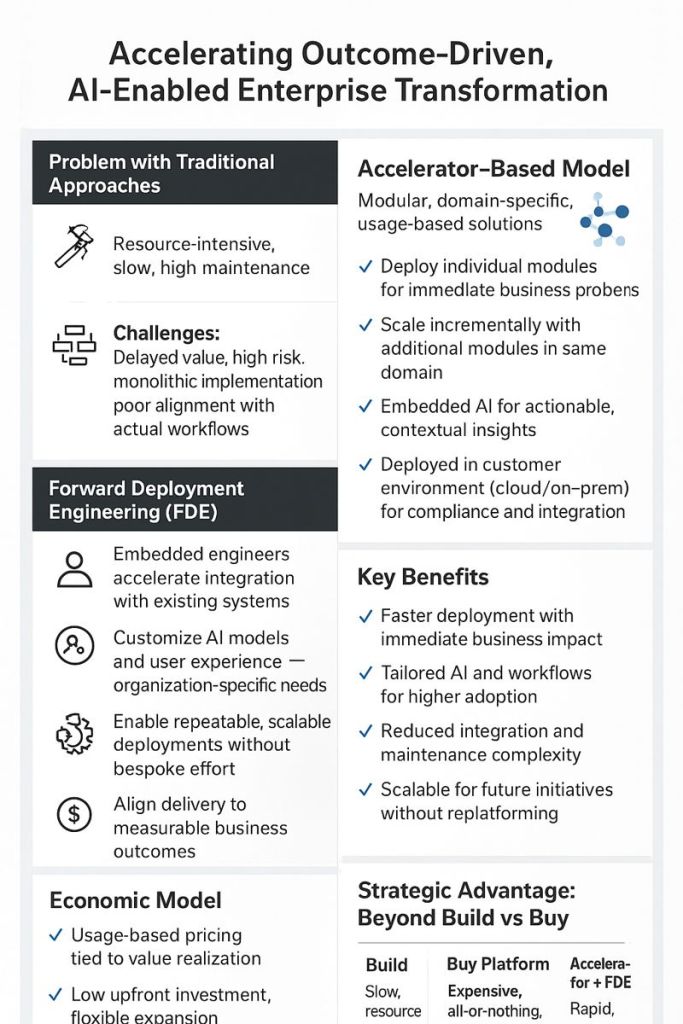
  • Forward Deployment Engineering: Embedded for Impact

    Forward Deployment Engineering (FDE) embeds engineering teams directly into the customer environment to deliver measurable business outcomes. Forward-deployed engineers configure, integrate, and evolve solutions in real operational contexts, ensuring alignment with workflows, data, and regulatory requirements.

    FDE accelerates value realization by enabling rapid iteration, operational customization, and continuous optimization. It also scales through reusable integration patterns, AI configurations, and workflow templates, making deployments repeatable without bespoke effort for each new use case.


    The Accelerator-Based Model: Targeted Capability Enhanced by Forward Deployment Engineering

    Many large enterprise vendors offer broad platforms with domain-specific functionality, but these offerings typically require customers to activate most or all modules to realize value. Adoption is often tied to multi-year rollout programs, significant upfront licensing commitments, and, in many cases, partial or full replacement of existing systems. This approach concentrates risk early, delays time to value, and forces organizations to pay for capabilities long before they are operational.

    The accelerator-based model is fundamentally different. Enterprises license discrete, domain-specific accelerators designed to solve immediate business problems. Each accelerator is deployed independently, priced based on actual usage, and integrated into the existing technology landscape without requiring wholesale system replacement. Additional capabilities can be introduced incrementally through adjacent accelerators within the same domain, allowing organizations to scale at their own pace.

    The effectiveness of this model depends heavily on selecting a vendor with the right capabilities. Key vendor selection criteria include:

    • Shared data and AI services across modules, ensuring consistent integration and governance
    • Proven forward deployment engineering capability, enabling rapid, scalable adoption
    • In-environment deployment maturity, for seamless operation within customer cloud or on-premises infrastructure
    • Clear usage-based pricing metrics, ensuring predictable economic alignment with outcomes

    Forward Deployment Engineering amplifies the value of this model by accelerating integration with existing systems, tailoring AI behavior, and configuring workflows to meet organization-specific requirements. FDE ensures that accelerators deliver immediate, contextualized value while remaining extensible for future use cases.


    AI Enablement Embedded Across the Stack

    Within this modular architecture, AI enablement is embedded across the entire stack. Accelerators leverage shared AI services—such as model management, inference, monitoring, and feedback loops—while applying them in domain-specific contexts.

    Because AI capabilities are offered by the vendor, native to the architecture rather than bolted on per module, enterprises avoid duplicative tools, AI enablement teams that work outside the domain, expensive model development or fine tuning and inconsistent governance. Forward deployment engineers ensure that AI is operationalized responsibly and effectively within the customer’s environment and enabled in the experience serving the domain.


    Cloud-Native Deployment and Compliance

    Accelerator-based solutions are deployed directly within the customer’s cloud environment—public, private, or hybrid. Forward deployment engineering ensures alignment with enterprise security, identity, observability, and compliance requirements, reducing operational friction while preserving flexibility.

    This deployment model preserves prior technology investments while enabling rapid, low-risk delivery of new capabilities.


    Usage-Based Pricing Aligned with Outcomes

    Each accelerator is priced based on actual usage, rather than platform capacity or multi-year contractual assumptions. Enterprises pay for the modules deployed and the value they generate. This model reduces upfront investment, supports experimentation, and ensures expansion is aligned with realized value.


    Business and Architectural Benefits

    The accelerator-based approach delivers tangible advantages:

    • Low initial investment through modular deployment and usage-based pricing
    • Faster integration with existing systems using forward deployment engineering
    • AI and experience tailored to organizational needs, improving adoption and outcomes
    • Reduced integration and maintenance cost via shared domain architecture
    • Lower risk by avoiding monolithic replacements
    • Scalability of both modules and forward deployment practices, enabling consistent operations

    This approach ensures organizations gain reusable, domain-specific capabilities without the overhead of fragmented solutions or bespoke development.


    Reimagining Technology Delivery: Beyond Build vs Buy

    Combining forward deployment engineering with modular, domain-specific accelerators reframes the classic technology decision:

    Accelerator + FDE: Rapid, usage-based deployment with targeted AI enablement, scalable integration, and incremental expansion

    Build: Resource-intensive, slow, high maintenance

    Buy (large platforms): Expensive, all-or-nothing, delayed ROI

    By embedding AI-enabled, modular solutions in real workflows, enterprises can achieve continuous, outcome-driven transformation without large-scale platform replacement or bespoke development.