Part two of three on the shape of the enterprise technology organization.
An organization can collapse every reporting line it has and still be slow, because the systems underneath have boundaries of their own. Those boundaries were drawn on a cost argument that no longer holds.

A Shared System Is a Shared Queue
Take a firm with clinics, a manufacturing operation, and the usual enterprise functions. No single application covers that. There will be an EHR, a manufacturing system, SAP or Workday, and if the firm sells direct, commerce and order management as well.
Give every domain its own team and its own leader, exactly as part one describes. Then put two of them on the same SAP instance.
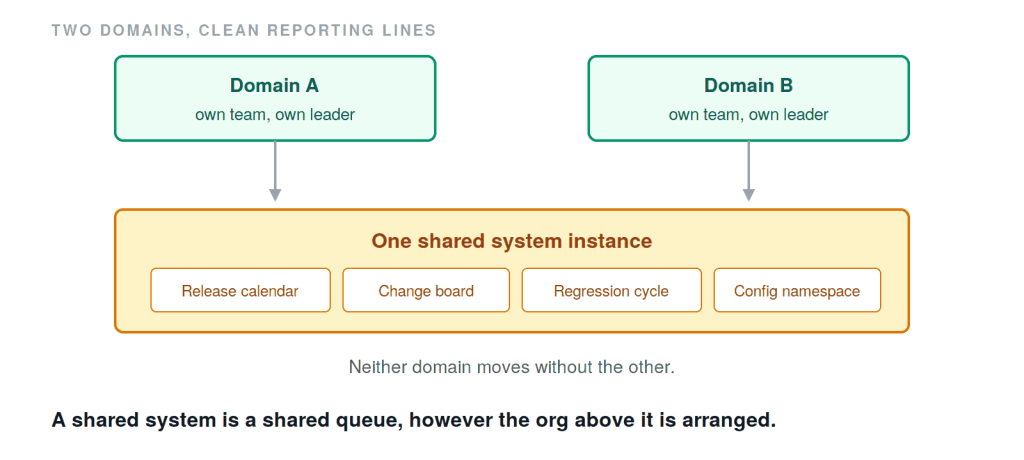
They now share a release calendar, a change board, a regression cycle and a configuration namespace. Neither moves without the other. The reporting lines are clean and the queue is still there, because the queue was never really about the people.
The key point:
A shared system is a shared queue, however the organization above it is arranged.
The Argument That Built Those Queues
Consolidation won for a good reason. Every extra system meant another integration, another reconciliation, another environment, another team who knew how it worked. One platform serving three domains was genuinely cheaper than three.
So arguments about where a boundary belonged got settled that way — by whichever system was biggest, or whichever leader argued hardest.
Two things changed. Building and maintaining got far cheaper, and the reconciliation that once required identical systems now happens in the data platform afterward.
License cost did not change. But license cost is a line item and dependency is a constraint on the business, and enterprises have spent twenty years optimizing the line item.
The Rule
No system sits inside the workflow of more than one business line.
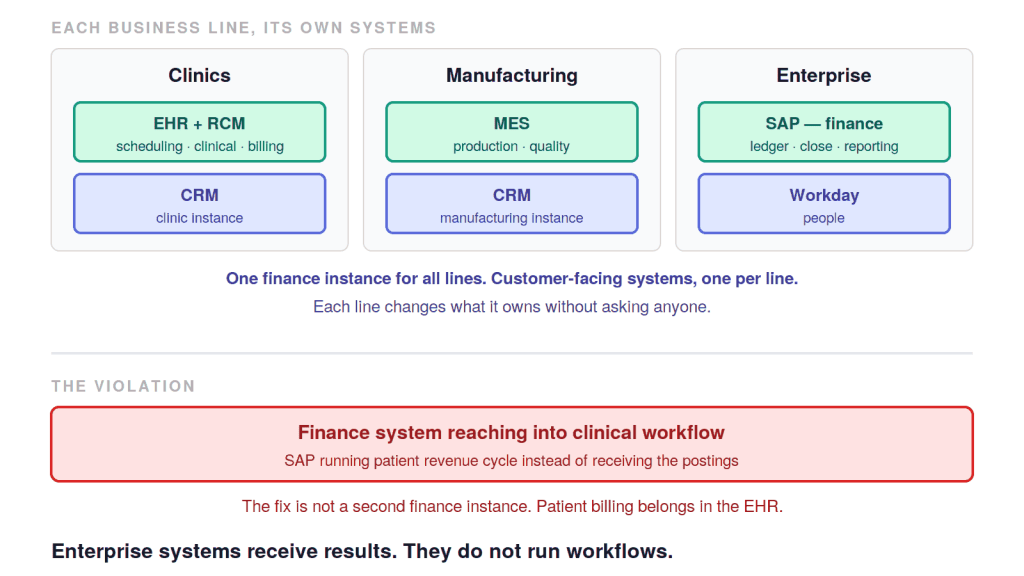
This is about what a system runs, not which vendor supplies it. One finance instance serving every business line is correct — that is the ledger doing its job. Where the same product is customer-facing, separate instances per line are usually the cheaper answer: two lines on the same CRM with their own configuration and release calendars stay independent of each other.
The simpler version — one system per domain — is also wrong. Epic spans scheduling, clinical documentation and revenue cycle, and that is correct: one value chain, one business line, and revenue cycle in healthcare moves with clinical workflow rather than with finance.
The violation looks different. SAP running the general ledger is finance doing its job. SAP running patient revenue cycle puts a finance release calendar inside a clinical workflow, and the clinic has lost control of its own speed.
The same test kills the obvious efficiency on the retail side. Patient billing and eyewear order billing look like one capability. They serve two businesses with different cadences, regulators and customers. Share the system and retail waits on a clinical release.
Duplication is the price, and two horizontals make it affordable. Identity, because the same person is a patient and a customer. The data platform, because independent systems do fragment reporting — and that is answered by converging at the analytical layer rather than the transactional one.
Independence where the work happens. Convergence where the questions get asked.
The key point:
Enterprise systems receive results. They do not run workflows.
When Nothing Owns the Experience
Where one system spans a business line end to end, it owns the customer experience too. A health system on a single EHR has a natural home for scheduling, results and balances. Take that when it exists.
Three chains on three EHRs is the harder and more common case. The conventional answer is a multi-year consolidation program where the patient notices nothing until the end.
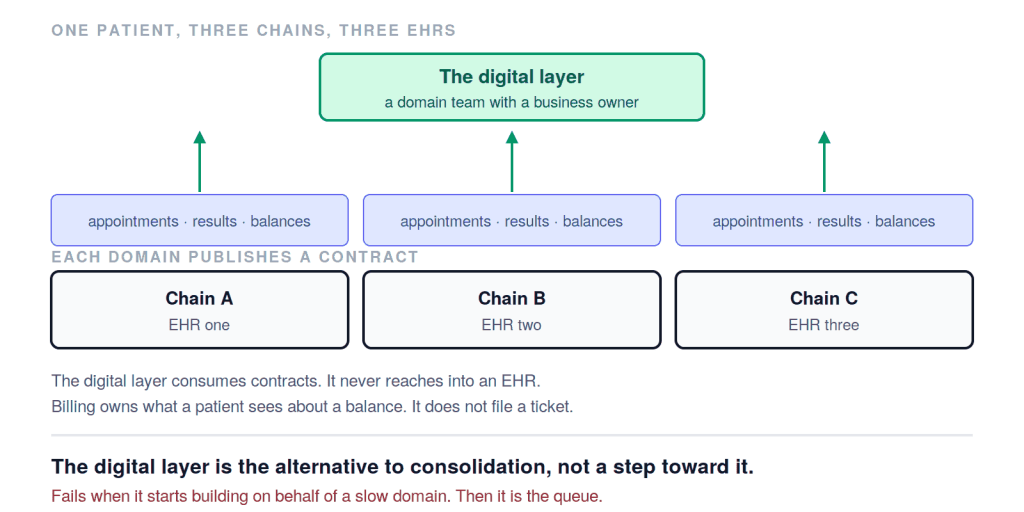
The alternative is to build the digital layer and leave the EHRs different. It breaks no rule — a layer spanning three EHRs serves one business line that happens to run on three systems. And it changes the strategic position: consolidation becomes optional rather than a precondition for improvement.
Two constraints worth stating. Reading across systems is achievable; writing back is hard, and scheduling is the worst of it. And identity is the precondition, because showing one patient another patient’s results is the failure that ends the program.
The key point:
The digital layer is the alternative to consolidation, not a step toward it.
Who Owns It, and What Is Left
The digital layer is a domain team with a business owner, not a service bureau. Each clinical domain exposes a contract — appointments, results, balances — and the digital domain consumes contracts rather than reaching into an EHR.
That distinction is the whole thing. The digital team owns the patient-facing product. Domains own their capability and their content. When billing wants to change what a patient sees about a balance, billing changes it.
The failure mode is specific and it happens every time: the digital team starts building on behalf of a domain because that domain is slow. At that point it becomes the queue everyone waits in.
And something real remains. Two domains sharing a contract still have to agree on when it changes — two backlogs, one release, a conversation between two leaders about sequence. No structure removes that. It is genuine coupling, not organizational residue.
It can eventually be automated, but only afterward. Automating the handoff while sixteen groups still exist is what produced middleware and robotic process automation, and how a twelve-month project ends in an exception queue.
Final Thoughts
For twenty years the answer to where a system boundary belonged was whoever argued hardest, defended by a cost case nobody could check.
That cost case has changed. What replaces it is a principle: boundaries follow business lines, duplication is affordable, and convergence happens where the questions are asked rather than where the work is done.
Collapse the bridge first. Then automate what remains.
Part three covers the people — who the model depends on, and why the current shape has hidden them.
 Tech Canvas