Most enterprise AI will not be code your teams wrote. It will arrive inside the platforms you already bought — a feature in a release note, a toggle enabled by default. A platform of gateways and prompt registries governs the minority of your portfolio. Whatever governs the rest has to be expressed as what you require, not what you run.
Fourth and last group in a component-by-component teardown. The overview is in The Enterprise AI Platform: What’s Left When You Unpack It.
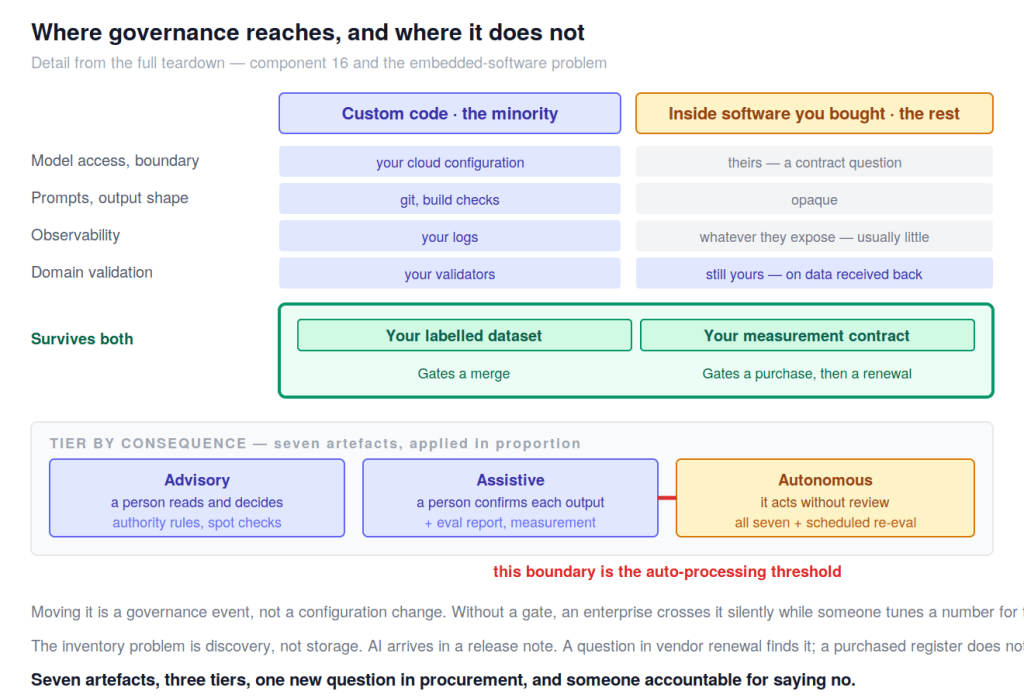
What Reaches, and What Does Not
| Capability | Custom code | Inside software you bought |
|---|---|---|
| Model access and boundary | Your cloud configuration | Theirs — a contract question |
| Prompts and output shape | Your source control | Opaque |
| Observability | Your logs | Whatever they expose. Usually little. |
| Domain validation | Your validators | Still yours — on data you receive back |
Two things survive both columns: your labeled dataset and your measurement contract. Neither is a platform component, and both are vendor-independent by construction.
The practical consequence is that your evaluation dataset belongs in procurement. “What accuracy does this achieve on our 200 cases, and can we retest at renewal” is the only real lever over an embedded AI feature — and no function in most enterprises currently asks it.
Seven Artifacts
Everything that survived the teardown lands here.
- Accuracy report — the standard format, published before release
- Threshold and rationale — signed by the business owner, because “why 92%” has a dollar answer
- Measurement contract — what gets recorded when a person reviews output
- Authority declaration — what the output is permitted to cause, and what it can never cause
- Unit cost — against the manual baseline, captured before go-live
- Data classification — what class of data, and where inference runs
- Vendor terms — for anything embedded
Seven items. That is a form, reviewed in the forums you already run.
AI needs new questions in those forums, not a new forum.
Tier It, or It Gets Ignored
Requiring all seven for every use of AI would be quietly routed around. Tier by what happens when it is wrong.
- Advisory — a person reads it and decides. Authority declaration and periodic spot checks.
- Assistive — a person confirms every output. Add the accuracy report and measurement contract.
- Autonomous — it acts without per-case review. All seven, plus scheduled re-evaluation.
The boundary between assistive and autonomous is your auto-processing threshold. Which gives the single most useful rule in the framework.
Without it, an enterprise crosses from assisted to autonomous silently, while an engineer tunes a number to improve throughput. Nothing announces that the human control was removed.
And this is the one place governance needs data rather than a form. If every capability lands its review records in a common place, the share running without human confirmation is a query, not a survey. Without it, tiering is a policy you assert. With it, tiering is a policy you can see.
Moving the threshold is a governance event, not a configuration change.
The Inventory Problem Is Discovery, Not Storage
You need to know where AI is running. A purchased register is accurate on the day it is populated and stale within a quarter.
And it does not find the AI you most need to know about — the feature that shipped in a release, or the toggle enabled by default. No request was filed. No architecture review triggered.
What works is one question in three places you already have: vendor renewal, new software procurement, and release-note review for platforms already in place.
The inventory is a spreadsheet fed by those checkpoints. Keeping it current is the work. The container is irrelevant.
Who Owns It
Not a new team. The measurement table needs someone reading it monthly, and thresholds need reviewing quarterly with the owners who signed them.
The division that works is a central view and a local fix. Central sees what no single team can — the same failure across three capabilities, a threshold that moved without a decision, a correction rate near zero that means reviewers stopped checking. The team that wrote the code makes the change.
One hard rule, and only one. A change to the auto-processing threshold requires a published report and a signature. Everything else is advisory.
Describe the role as monitoring quality and delivery teams will hear an audit function, then manage the number instead of the system.
The Whole Series, Decoded
| What it is called | What it is |
|---|---|
| Model gateway | IAM, a private network path, and cost tags |
| Prompt management | A folder in source control |
| Structured output layer | One parameter on the request |
| Guardrails | A config toggle, a validation function, and three written rules |
| AI evaluation platform | 200 labeled cases and a scoring script |
| LLM observability | A log line, plus a join to what happened next |
| Golden dataset infrastructure | Records you already have, plus two days marking provenance |
| Human-in-the-loop service | A screen in the application |
| Vector database | A feature of the database you already run |
| Agent runtime | A function, once someone writes the sequence down |
| Model registry, feature store, GPU platform | Real only if you train models |
| AI governance platform | A form and a gate |
Every row on the right is something an enterprise already knows how to do. That is the finding.
The difficulty was never technical. The vocabulary made familiar work look like new infrastructure, and new infrastructure looks like it needs a team.
Strip the vocabulary and what remains is a form, a gate, and someone accountable for saying no.
Final Thoughts
Sixteen components, taken apart against real work.
One piece of infrastructure, owned by a team you already have. One shared table. Two schemas. A handful of build checks. A form and a gate.
The rest was existing systems, existing teams, and existing forums — wearing names that made them look new.
Governance is not a platform to buy.
It is a question someone has to ask.

