Most discussions about AI automation quickly converge on agents. The reality is that enterprises automate work in very different ways depending on where the process resides. Understanding those patterns is often more important than choosing the latest AI framework.
Process Automation AI Starts with the Process
One of the recurring themes in enterprise architecture is that technology choices should follow business context.
Process Automation AI is no different.
The most important question is not:
Which agent framework should we use?
It is:
Where does the process live today?
The answer to that question often determines the architecture, technology choices, governance requirements, and operating model that follow.
A customer service workflow inside ServiceNow is not the same problem as claims processing in a strategic application. Neither resembles an invoice workflow spanning email, ERP systems, approval processes, and vendor communications.
Yet many AI automation discussions treat them as variations of the same problem and immediately jump to agents, orchestration frameworks, and autonomous workflows.
In practice, enterprises encounter three distinct automation patterns, each requiring a different architectural approach.
The Three Process Automation Patterns
| Pattern | Where the Process Lives | Typical Examples |
|---|---|---|
| SaaS-Native AI | SaaS Platforms | CRM, ITSM, ERP, HR |
| AI-Enabled Strategic Applications | Core Business Applications | Claims, Underwriting, Supply Chain, Industry Platforms |
| Cross-System Automation | Multiple Systems | Invoice Processing, Onboarding, Order Fulfillment |
The most important architectural question is often not which AI technology to use.
It is:
Where does the process live today?
Pattern 1: SaaS-Native AI
When a process already lives inside a SaaS platform, the most practical approach is often to leverage the AI capabilities provided by that platform.
Examples include:
- Salesforce
- ServiceNow
- SAP
- Workday
- Microsoft Dynamics
Capabilities range from summarization and recommendations to workflow execution and task automation.
Many vendors now market these capabilities as copilots, assistants, or agents. From an enterprise architecture perspective, these distinctions are less important than the underlying principle.
The process already exists inside the platform.
The AI capability is simply an extension of that platform.
Architecture Principle
Start with the AI capabilities already embedded in the platform before building custom solutions.
What Is New?
| Existing Capability | AI Augmentation |
|---|---|
| CRM, ERP, ITSM, HR Platforms | Copilots, Recommendations, Summarization, Workflow Automation |
For many enterprises, this will be the fastest path to realizing value from AI.
Pattern 2: AI-Enabled Strategic Applications
Many of the most important enterprise processes do not live inside SaaS platforms.
They live inside strategic applications built and maintained by the organization over many years.
Examples include:
- Claims processing systems
- Underwriting platforms
- Supply chain applications
- Customer operations systems
- Industry-specific operational platforms
- Legacy systems supporting core business processes
These applications often contain decades of business logic, process knowledge, integrations, and organizational expertise.
Replacing them is rarely practical.
Instead, AI provides an opportunity to modernize the user experience while preserving the underlying business capabilities.
This typically occurs in two stages.
Stage 1: Understanding the Application
Many organizations struggle with applications that have evolved over years and are poorly documented.
AI can help reverse engineer:
- Business rules
- Process flows
- Data relationships
- User journeys
- System dependencies
This creates a foundation for modernization.
Stage 2: AI-Enabled Experiences
Once the application context is understood, AI can be embedded directly into the workflow.
Examples include:
- Process guidance
- Rule interpretation
- Case summarization
- Form completion
- Next-best-action recommendations
- Contextual knowledge retrieval
The objective is not to replace the application.
The objective is to reduce cognitive load, reduce navigation complexity, reduce the number of user interactions, and present information in a more meaningful way.
A claims processor may no longer need to navigate five screens to understand a case. The AI can assemble and present the relevant information within the context of the task being performed.
Architecture Principle
Preserve the business process and underlying application while using AI to simplify how users interact with it.
What Is New?
| Existing Capability | AI Augmentation |
|---|---|
| Strategic Applications | Reverse Engineering, Process Discovery, Summarization, Recommendations, Workflow Guidance, Conversational Interfaces |
For many organizations, this may represent one of the highest-value AI opportunities because it improves productivity within the systems employees use every day without requiring a major application replacement program.
Pattern 3: Cross-System Automation
This is where many of today’s AI architecture discussions originate.
The process spans multiple systems and often begins with a document, email, event, or request.
A typical workflow might look like:
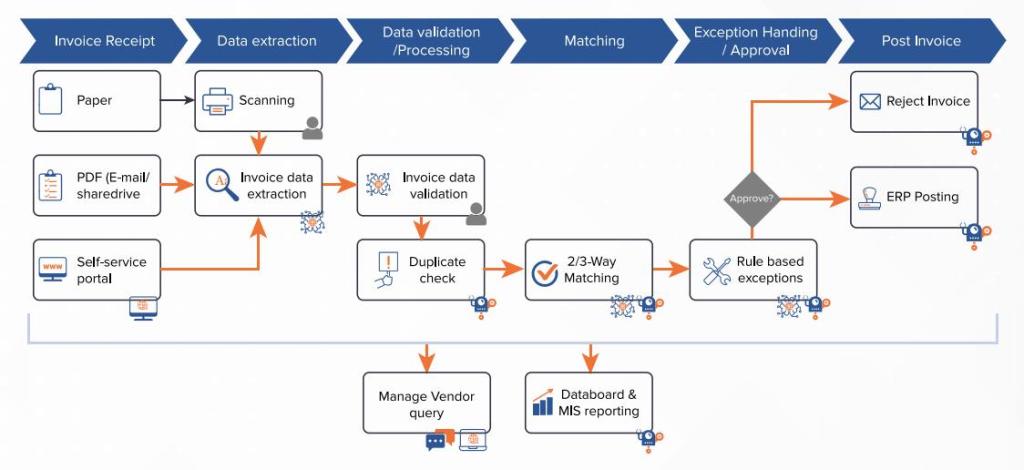
The challenge is coordinating work across systems.
This is where many of today’s AI buzzwords begin to appear:
- Agent runtimes
- Workflow orchestration
- RPA
- Tool access layers
- MCP
- Human approvals
- Exception handling
However, focusing on the technology often obscures the actual problem.
The objective is not to maximize autonomy.
The objective is to automate work safely across enterprise systems.
Architecture Principle
Focus on orchestrating work across systems rather than building autonomous agents.
What Is New?
| Existing Capability | AI Augmentation |
|---|---|
| Workflow Engines | LLM Reasoning |
| BPM Platforms | Document Understanding |
| RPA | Agent Runtime |
| APIs | Tool Access Layer |
| Human Approvals | Confidence-Based Routing |
Unlike SaaS-native AI and AI-enabled strategic applications, cross-system automation introduces a new challenge: coordinating work across documents, workflows, APIs, enterprise applications, and people.
This is where concepts such as workflow orchestration, agent runtimes, RPA, tool access, and governance begin to matter.
We’ll explore these architectural considerations in the next article when we take a deeper look at Enterprise Agentic Architecture.
Bottom Line
Most enterprise process automation discussions begin with agents.
A better place to start is the process itself.
Enterprise automation generally falls into three patterns:
- SaaS-Native AI
- AI-Enabled Strategic Applications
- Cross-System Automation
The first pattern leverages AI capabilities embedded within SaaS platforms.
The second modernizes strategic applications by helping users navigate complexity and interact with decades of accumulated business logic more effectively.
The third introduces a more significant architectural challenge: coordinating work across systems, workflows, documents, APIs, and people.
The challenge is not choosing an agent framework.
It is understanding where the process resides and applying the right automation pattern to create business value.
Once that decision is made, the architecture becomes much clearer.

