A supporting read for The Agentic Enterprise Needs a Spine, Not a Mesh. The agentic mesh is not new. It is the latest name for a layer the industry rebuilds every technology wave — and the reason it kept coming back has finally gone away.
The agentic mesh is being sold as the architecture of a new era. It is not new. It is the fifth time in twenty-five years that the industry has promised autonomy at the edge and then built a coordinator in the center — and the fifth time the center is set to become the thing everything waits on.
It is worth walking the lineage, because the pattern is the argument.

Five Names for the Same Layer
SOA gave us the bus. Service orientation promised loose coupling: independent services, composed freely. What it delivered was the enterprise service bus — a central mediation layer that every call traversed and every team queued behind. The ESB was the middle, and governing it became a department.
Microservices gave us the mesh. The reaction to the monolith promised decentralization: small services, owned by small teams. What it reintroduced was the API gateway and, literally, the service mesh — Istio, Linkerd — a dedicated layer for everything to talk through. The word “mesh” is not new to this moment. It is already an era old.
Integration gave us the hub. The work of connecting systems became a product category: EAI, then the ESB again, then iPaaS — MuleSoft, Boomi, Workato. A central hub whose entire purpose was to sit between everything else.
Cloud gave us the control plane. Elastic, distributed, self-service — and then the landing zone, the shared-services account, the central platform team, the control plane that every workload depends on. A new middle wearing an infrastructure badge.
AI gives us the agentic mesh. An orchestration layer that coordinates agents, a shared ontology so they can reason across domains, a clean core that everything still routes through. The same organ, the latest costume.
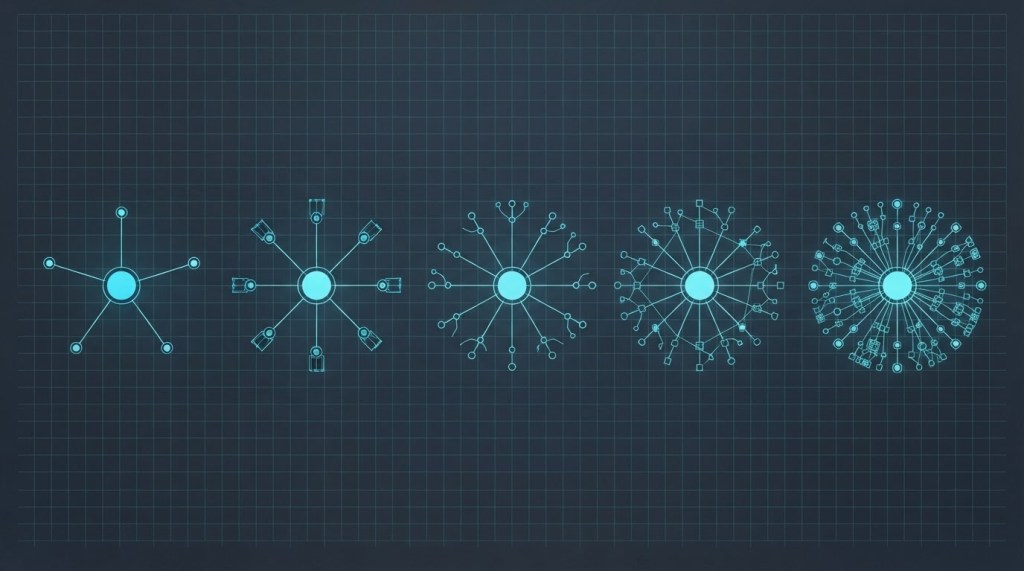
Each wave began by promising to dissolve the center. Each one rebuilt it. And each center became the constraint — the place where change slowed down, where coordination turned into a queue.
And the center was never only the technology. Each central tool gathered an organization around it — an integration team that owned it, a governance board that gated every change, a release train everyone had to synchronize to. The software was the smallest part. What made the queue slow was the standing apparatus of teams and process the center required.
The key point:
The middle is not a technology. It is a reflex. The names change every decade; the organ does not.
Why It Kept Coming Back
The reflex was not stupid. It was rational, every time.
Connecting two systems used to be expensive. Each new connection was a project — an interface, a transform, a team that understood both ends. When connection is costly, a shared coordinator is the economical shortcut: build the integration once, in the center, and let everyone draw on it. The ESB, the mesh, the hub, the control plane — each was a sensible answer to the same real problem. Point-to-point did not scale, so the industry centralized.
That is the part the vendors are right about. For twenty-five years, the middle earned its place — connectivity, standardization, governance, reliability were real needs, and these technologies met them. The one thing none of them ever delivered was speed.
What Is Different Now
One thing has changed, and it is the only thing that matters: the cost that forced the middle has collapsed.
Standing up a contract between two domains — an API, an MCP endpoint over a domain’s data and the actions it will take — is now a day’s work, not a project. When connection is nearly free, the economic reason for a central coordinator is gone. There is no integration to amortize, no transform to reuse, no reason to route through a center to avoid paying for the edge.
So this time the move is not to replace the mesh with a better mesh. It is to notice that the condition that made a mesh necessary has lifted. Domains connect directly, by contract, peer to peer. There is no center because there no longer needs to be one — and with no center, there is no apparatus to staff around it, which is where the speed finally comes from.

The key point:
Every prior wave rebuilt the middle because it had to. This is the first wave that doesn’t.
The Objections, and Why They Don’t Hold
This argument will be challenged, and the challenges are worth taking at their strongest — not their weakest.
“Point-to-point connections explode into N². The mesh exists to tame that.” This was true when every connection was bespoke. It is not true when contracts are standardized: connections are not hand-built, most domains talk to only a few others, and the many-to-one analytical fan-in is absorbed by the data platform. The result is a sparse graph of cheap, standard edges, not a dense web of custom ones. And a mesh does not remove the connections — it routes them through a center. It trades N² edges for one chokepoint, and the chokepoint is what becomes the queue.
“Agents need a shared ontology to reason across domains.” Semantics belong at the edges of a contract — two domains agree what a term means in the contract between them — not in a central brain every domain must conform to. A universal enterprise ontology is the consolidation fantasy in a new suit: it never converges, it becomes a program. Local agreement scales. Global agreement does not.
“A modern mesh is not the old ESB — the data plane is distributed.” True, and beside the point. What hurt the enterprise was never the deployment topology; it was that everyone conformed to and waited on a shared layer. A distributed data plane with a central control plane still has a control plane that everything depends on. The control plane is the queue even when the data plane is not.
There is one objection that does hold, and it is worth conceding plainly. Someone still owns the end-to-end promise to a customer whose work spans several domains, and getting one domain to reliably act on another’s request — writing back across a boundary — is genuine, unglamorous work. Removing the middle does not remove that. It just stops pretending a coordinator was ever doing it well. That is the real work the structure leaves behind, and it is addressed where it belongs, in the piece on how domains cross.
Build, Buy, and Where the Mesh Belongs
An organization that builds and runs its own software at scale still needs a mesh, and this is not an argument against that. Service-to-service traffic, observability, policy enforcement across systems you actually control — a mesh is the right tool for that work, and the teams doing it are not the audience here.
This argument is for the other enterprise: the one anchored on software it bought, whose goal is to simplify its domains rather than to operate a distributed system of its own making. There, a mesh does not solve a problem you have — it imports one. You take on the cost and the center of a thing built for people who write their own platforms, to coordinate systems you only configure.
This cuts the other way too, and it matters. A domain large enough to build, buy, and run real systems of its own may well need a mesh inside its own boundary — and it should have one. The argument is not against a mesh anywhere; it is against one mesh across the whole enterprise. What changed is the economics of that larger bet: centralizing to capture synergies across the entire organization used to be worth the dependence it created, and it no longer is. So the rule is independence first — keep the mesh, where it is needed, inside the domain that runs it, and stop paying for a center whose synergies no longer cover its cost.
So the line is not that the mesh is wrong, and it is not that the integration tools before it failed — most did exactly what they were built to do. It is that the mesh is for builders, and that none of these layers ever gave the enterprise the one thing it most needs now: speed, because a shared center is always a queue. For the enterprise that buys and wants to move, what finally changed is not the sixth name. It is that the reason for the center is gone.

