Tech Canvas
Technology insights, Authored with Prompts and GenAI
Category: Traditional EA Practices
The articles describe how traditional EA practices—characterized by hierarchical operating models, heavy governance, and static documentation that quickly becomes stale—can evolve into a dynamic, collaborative function that drives measurable business value and optimizes the CIO organization by embedding a lean internal consulting EA team alongside portfolio architects and platform product owners; together, they contribute to an AI-enabled, living knowledge base of architectural decisions, standards, and patterns that empowers teams with prescriptive guidance, fosters cross-team collaboration over top-down enforcement, accelerates decision-making, and aligns technology investments directly with business outcomes.
-
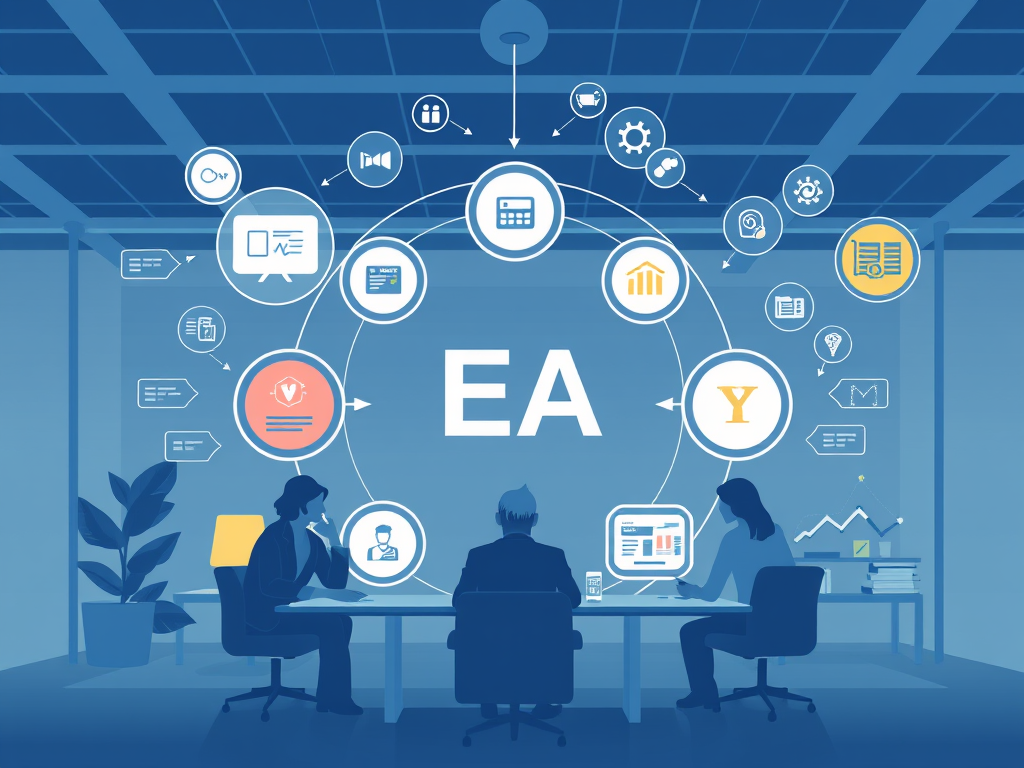
From Ivory Tower to Value-Driven Enterprise Architecture Enterprise Architecture (EA) has long faced the challenge of being perceived as an “ivory tower” — a distant, slow-moving function that produces bulky documentation with limited direct business impact. This traditional model often struggles to keep pace with rapid technological change and evolving business demands, leaving stakeholders frustrated…
-

Evolving the Traditional EA Library into an AI-Enabled Knowledge Ecosystem Enterprise Architecture (EA) has traditionally relied on static libraries—repositories of standards, policies, and reference architectures—that often become outdated, siloed, or disconnected from real-world delivery teams. These conventional libraries, managed top-down, struggle to keep pace with fast-evolving technologies and dynamic business demands. To unlock true business…
-

Governance is often misunderstood as a relic of slow-moving enterprises. But in reality, it is a critical enabler of sustainable, aligned decision-making — especially in businesses undergoing complex transformation across multiple fronts. These are not software-first or tech-native companies. They are organizations in healthcare, insurance, retail, logistics, and manufacturing — whose business models are not…
 Tech Canvas