🔧 What Does Enterprise IT Actually Do?
At a strategic level, an enterprise IT organization exists to deliver two primary value streams:
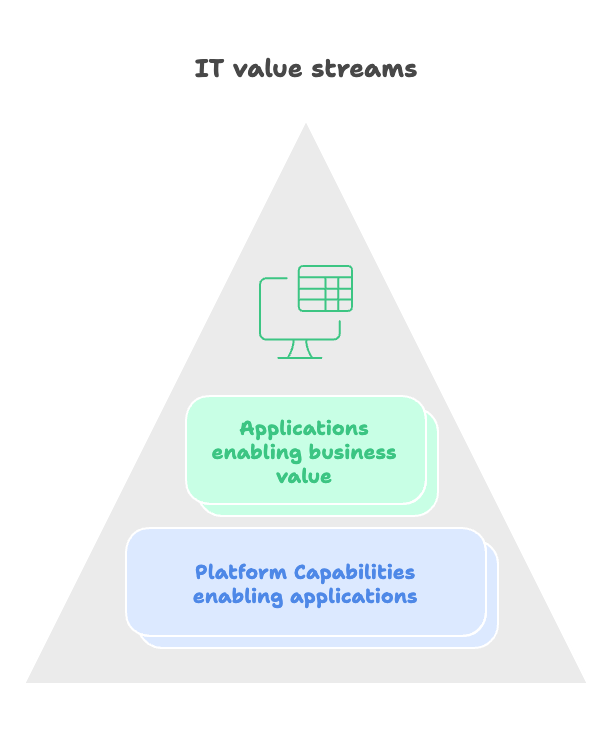
Business Applications — the software systems that directly enable business capabilities, customer engagement, operational workflows, and decision-making. Business applications are how the enterprise interacts with the world.
Platform Capabilities — the shared systems and services that provide the foundations, tools, and infrastructure for building, deploying, securing, and scaling those business applications. Platform capabilities are how IT makes that delivery repeatable, secure, efficient, and fast.
While many organizations have embraced agile and product thinking for business applications, the platform side often remains siloed, underfunded, and organized around legacy service models. That gap increasingly limits enterprise agility.
Most organizations — if they haven’t already — are moving to structure their delivery teams around value streams, aligning to frameworks like SAFe (Scaled Agile Framework) and the organizational guidance found in Team Topologies (by Matthew Skelton and Manuel Pais). This shift enhances focus, flow, and customer-centricity — but it’s only part of the puzzle.
1. What is a Platform Team?
A platform team, as defined in Team Topologies (by Matthew Skelton and Manuel Pais), is a team that provides internal products — reusable services, tools, and APIs — that enable other teams to deliver faster and with reduced complexity.
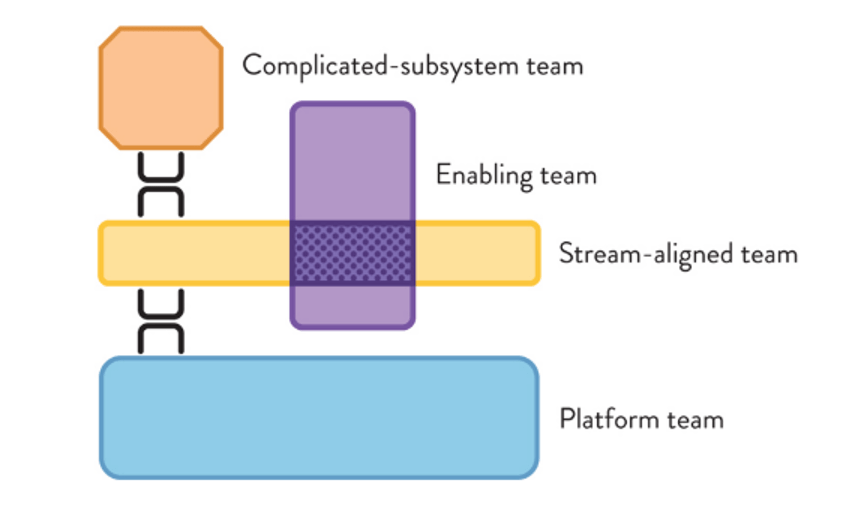
These teams own platform capabilities like:
- CI/CD pipelines
- Cloud and infrastructure as code
- Integration layers (e.g., APIs, Kafka, Event Hubs)
- Data pipelines and ML ops
- Identity and access services
- Observability, logging, and monitoring
Unlike shared services of the past, platform teams:
- Act like product teams with backlogs, roadmaps, and internal user feedback
- Deliver self-service capabilities that reduce cognitive load
- Are measured by adoption, developer experience, and enablement
2. Why Do Traditional IT Setups Struggle to Organize Around Platforms and Fund Them?

The pivot to platform thinking is difficult because traditional IT is structured and funded in a way that resists it. Here’s why:
🧱 Org Structure: Vertical Silos
IT organizations are usually split by function — infrastructure, dev, QA, middleware, DBA, PMO — with their own leaders, tools, and goals.
Infrastructure alone can include:
Collaboration tools and endpoint management
L1/L2 support and service desk
Compute and network
DBAs
Middleware (e.g., SFTP servers, ESBs, Kafka)
Cloud operations
These teams may account for 25–50% of IT headcount, but rarely operate with a product mindset. They’re optimized for uptime and compliance, not enablement.
💰 Budgeting: CapEx Mindset
These functions are often treated as fixed cost centers, capitalized and depreciated over time. Their budgets are static, tied to hardware cycles and licensing agreements.
So when a product-aligned team proposes a data platform, finance may ask:
“Don’t we already pay DBAs for that?”
Or when an integration platform is proposed, leadership may push back:
“Isn’t that what middleware does?”
This conflation of new platforms with legacy roles makes it almost impossible to justify funding — unless the org reframes platform as a modernization of the existing cost base, not an additional layer.
🧠 No Product Orientation
Infrastructure and middleware teams usually lack:
- Internal roadmaps
- Customer feedback cycles
- Delivery metrics tied to business outcomes
They operate via tickets and SLAs, not OKRs and value streams. Without a shift to a product mindset, platform teams will never emerge — and the agility of business teams will be blocked by outdated ways of working.
3. What Happens If Agile Product Teams Exist Without Platform Thinking?
This results in a split-brain IT model:
| Product Teams | Platform / Infra Teams |
| Agile, sprint-based, backlog-driven | Waterfall, ticket-based, siloed |
| Rapid iteration | Slow provisioning cycles |
| Focus on customer value | Focus on system uptime |
| Empowered, autonomous | Constrained, reactive |
This leads to:
- Coordination overload
- Delays in delivery
- Frustration between teams
- Duplicated effort and tool sprawl
Without aligning platform teams to the same agile operating model, agility becomes inconsistent, unsustainable, and fragmented.
4. How Can You Fund and Organize Platform Teams Effectively?
To address this challenge, CIOs and architecture leaders must take deliberate steps to modernize both the structure and financial treatment of platform work.
✅ Organizationally:
- Restructure existing infra, middleware, and data teams into cohesive platform teams aligned to internal products.
- Assign clear ownership for domains (e.g., cloud, integration, observability).
- Build team charters focused on accelerating developer velocity and improving delivery experience.
- Embed feedback loops with product teams to drive prioritization and platform adoption.
💸 Financially:
- Shift platform funding from static CapEx models to value stream–oriented OpEx models.
- Reclassify platform investments as part of the cost of product delivery.
- Fund via agile portfolios or capacity-based budgeting, not just project codes.
- Measure platform ROI through adoption, reuse, and reduction in duplicated tooling.
🧠 Final Takeaway
Enterprise IT is no longer just a service provider. It’s a product organization with two responsibilities:
- Delivering digital business capabilities through applications.
- Enabling those capabilities at scale through modern platform systems.
If only one of these functions evolves with the business, enterprise agility will stall.
The shift to platform teams isn’t optional — it’s how IT becomes a strategic enabler of speed, safety, and scale.
 Tech Canvas