
As organizations mature their product and platform operating models, a new opportunity emerges for Enterprise Architects: transitioning from technology stewards to platform product owners.
This shift allows architecture to play a more embedded, accountable role in delivering value while still ensuring technology coherence and long-term viability.
🏗️ Platforms Need Product Thinking
In agile, product-centric organizations, value stream-aligned teams typically include:
- Product Owners — responsible for prioritization, customer outcomes, and business alignment
- Portfolio Architects — providing guidance across multiple products to ensure coherence and scalability
However, platform teams are often left out of this structure, defaulting to deeply technical, ticket-driven operations. This creates a gap:
- Platforms lack roadmaps aligned with business demand
- Decision-making becomes reactive and cost-driven, not value-oriented
- There’s no clear owner responsible for platform usability, adoption, or lifecycle management
While value stream teams have strong product management, platform teams often don’t — and this is where Enterprise Architects can step in.
🎯 The Enterprise Architect as Platform Product Owner
Enterprise Architects with domain expertise (e.g., in integration, data, identity, DevOps, or cloud) are well positioned to become Platform Product Owners (PPOs):
| Traditional EA Role | Platform Product Owner |
| Sets reference architecture | Owns platform roadmap |
| Evaluates tools | Manages platform backlog |
| Provides governance | Gathers feedback from internal users |
| Writes guidelines | Prioritizes features for usability and scalability |
This evolution shifts architects from advisory to delivery ownership, allowing them to:
- Drive platform adoption through self-service and enablement
- Align platform capabilities to product team needs
- Track and improve internal platform metrics (e.g., time to onboard, NPS, cost per transaction)
👥 Who Should Be the Platform Product Owner?
The Platform Product Owner (PPO) role is not about title — it’s about mindset and accountability.
In practice, this role can be filled by:
- A technically strong Enterprise Architect who evolves from governance to ownership, or
- A forward-looking delivery head who is willing to operate with a product mindset
What matters is that this individual:
- Prioritizes platform usability, adoption, and internal customer experience
- Maintains a clear, funded roadmap with measurable outcomes
- Owns delivery, support, and continuous improvement
- Acts as a bridge between strategy (architecture) and execution (engineering)
The shift is from managing resources to managing outcomes — regardless of the person’s starting point.
This flexibility avoids rigid org structures and allows organizations to leverage existing talent as long as they embrace the platform-as-product philosophy.
🧠 The Role of Lean Architecture in a Modern IT Org
Rather than operating as a large, centralized “Ivory Tower,” modern Enterprise Architecture can evolve into three distinct, lean functions:
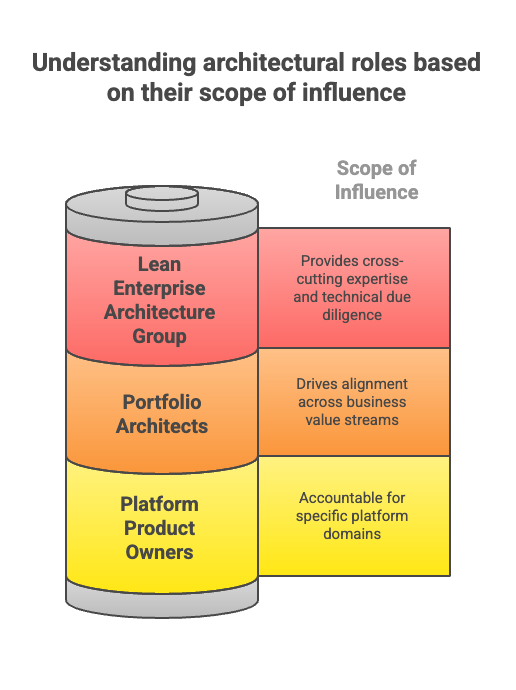
Lean Enterprise Architecture Group — a small, strategic team providing cross-cutting expertise and technical due diligence
Portfolio Architects — embedded in business value streams to drive alignment across domains
Platform Product Owners — accountable for specific platform domains (e.g., integration, data, DevOps)
This structure increases clarity, reduces friction, and enables architectural impact where it matters most — in delivery.
🔄 Reporting Structures and Architecture Community
The reporting structure for architects and platform product owners does not need to be centralized under a formal enterprise architecture organization. In fact, many organizations align architecture roles within delivery or platform organizations to maintain close proximity to execution.
What’s critical, however, is to preserve a strong architecture community that promotes:
- Knowledge sharing across domains
- Reuse of patterns and standards
- Peer reviews and architectural consistency
The Lean Enterprise Architecture Group plays a key role here, acting as a bridge across teams and ensuring continuity and alignment of architectural direction across the enterprise.
📈 Why This Transition Matters
Without product ownership, platforms risk stagnation, poor adoption, and misalignment. Transitioning Enterprise Architects into Platform Product Owners:
- Brings strategic oversight to platform investments
- Elevates the role of architecture in measurable outcomes
- Reinforces a product mindset across all layers of IT
It transforms platforms from technical utilities into internal products that enable scale, velocity, and optionality.
✅ Takeaway
Enterprise Architects must evolve from governance-only roles to hands-on platform product leaders for the platforms they’ve long guided.
The future of architecture is not just about setting standards — it’s about owning and evolving the internal products that power the enterprise.
 Tech Canvas