To effectively optimize technology spend, we must first establish a clear representation of the Enterprise. This foundation enables us to evaluate, document, and refine various models—not only to streamline systems but also to optimize labor costs.
Representing today’s Enterprise with a conventional reference architecture diagram alone often leads to confusion or oversimplification. A common pitfall is trying to represent capabilities, components, technologies, deployment models, and cloud services all in a single diagram. These overloaded visuals often lose clarity and purpose—serving more as a poster than a practical tool for analysis or decision-making.
In the past, reference architecture was typically equated with a neatly layered diagram—user interfaces at the top, business applications in the middle, and databases at the bottom. These diagrams served a clear purpose when enterprise systems were mostly homegrown, monolithic, and tightly coupled with point-to-point integrations.
But that era is gone.
Today, enterprise landscapes are dominated by SaaS platforms, cloud-native apps, hybrid deployments, and multi-cloud architectures. It’s time we stop treating reference architecture as a static diagram, and start treating it as a strategic guide that reflects the evolving complexity, composability, and modularity of modern enterprise technology.
What Is a Reference Architecture—Really?
Let’s clear up a common misconception:
A reference architecture is not an architecture diagram.
A reference architecture is a strategic guide. It captures:
- The current and target state of enterprise systems
- The evolutionary path of technology to support business transformation
- The key decisions, constraints, and tradeoffs around integration, data, security, and scalability
Yes, diagrams support it—but they’re just one of several artifacts.
It’s also not an application or platform inventory. For that, we have modern tooling (like CMDBs or EA platforms) that can auto-generate dynamic views. A reference architecture goes beyond cataloging. It provides context, intent, and direction.
The Legacy of the Architecture Diagram
Historically, architecture diagrams had a clear function:
- Communicate system structure
- Represent a specific viewpoint for a defined audience
- Anchor key decisions in visual form
In the early 2000s, when most systems were built in-house and closely integrated, the classic 3-layer diagram worked:
- User interfaces on top
- Application and middleware layers in the middle
- Databases and infrastructure at the bottom
These diagrams showed systems in stacks. They made ownership and dependencies clear. They mapped reasonably well to the internal IT landscape.
Why Traditional Diagrams No Longer Work
Today’s systems are platformized, modular, and often externally hosted:
- A single SaaS platform (e.g., Salesforce) can span all three traditional layers.
- Custom applications may include embedded analytics, native security, and infrastructure abstraction.
- Enterprise capabilities are built by stitching together services across multiple cloud providers.
Traditional architecture diagrams fail to capture:
- Cross-cloud and hybrid strategies
- Distributed data ownership
- Federated identity and security layers
- Composable application stacks with internal and external services
- The distinction between user-facing products and underlying platforms
The “stacked box” model needs an upgrade.
Cloud, SaaS, and the Rise of the Composable Enterprise
Reference architectures must now reflect:
- Multi-cloud reality: Most enterprises use both Microsoft and AWS (and sometimes Google Cloud). Microsoft dominates collaboration and identity, while others offer specialized compute or analytics capabilities.
- SaaS-centric architectures: Enterprises use dozens (or hundreds) of SaaS apps—each with its own data model, access pattern, and integration requirements.
- Cloud-native development: Strategic applications are increasingly built on PaaS and containerized services—not on-premise middleware.
- Data ownership and control: Data now flows between cloud platforms and SaaS providers. How do you ensure consistency, governance, and compliance?
- Unified observability and security: Monitoring and securing distributed systems requires consolidated platforms that enforce consistent policies and alerts.
A modern reference architecture needs to show this reality.
Products vs. Platforms: Why It Matters
Architecture diagrams often fail to distinguish between:
- Products: Bought, configured, and used (e.g., ServiceNow, Salesforce, Workday)
- Platforms: Extended, integrated, and built upon (e.g., AWS, Azure, Kubernetes, MuleSoft)
This distinction matters:
- Platforms have extensibility models, shared governance, and shared operational responsibility.
- Products typically solve bounded problems and are integrated into broader workflows.
Your architecture should make this semantic difference visible. It affects how solutions are architected, deployed, supported, and evolved.
Rethinking the Diagram: A Top-Down View
To reflect today’s enterprise reality, a modern reference architecture diagram should:
✅ Start from business domains, not just applications
✅ Show anchor technologies and strategic custom builds
✅ Map multi-cloud usage and integration strategy
✅ Include data ownership, API gateways, and observability
✅ Show security, integration, and infrastructure platforms as first-class layers
✅ Be modular, with different views for developers, architects, security teams, and business leaders
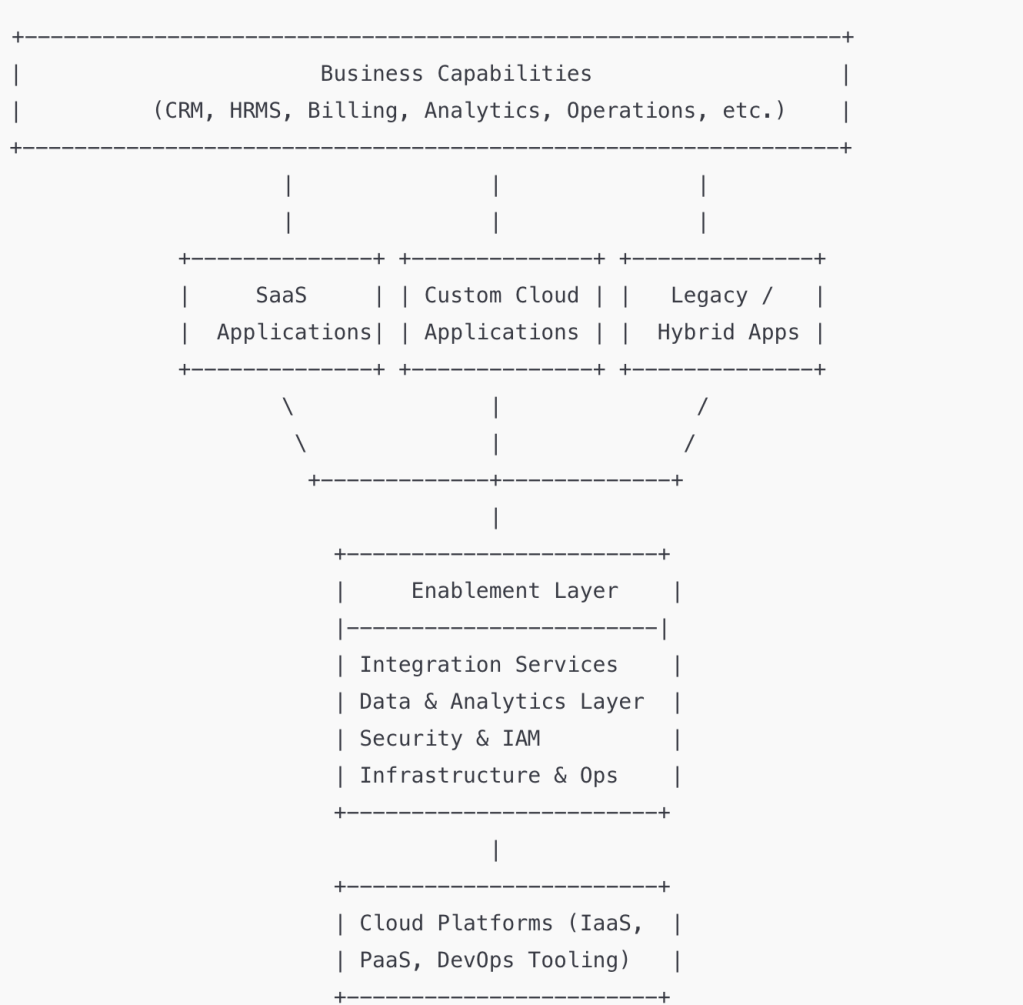
This is no longer a one-size-fits-all blueprint. It’s a flexible visual model—one that evolves along with your business and tech strategy.
Final Thought: Reference Architecture Is a Strategic Asset
Reference architecture isn’t just about diagrams—it’s about clarity, communication, and enablement.
Treat it like a product:
- Continuously updated
- Versioned
- Modular
- Stakeholder-aware
- Tied to tangible outcomes and transformation roadmaps
By rethinking both the what and the how of architecture, enterprise teams can shift from documentation to strategic alignment—delivering not just systems, but solutions that scale.
 Tech Canvas